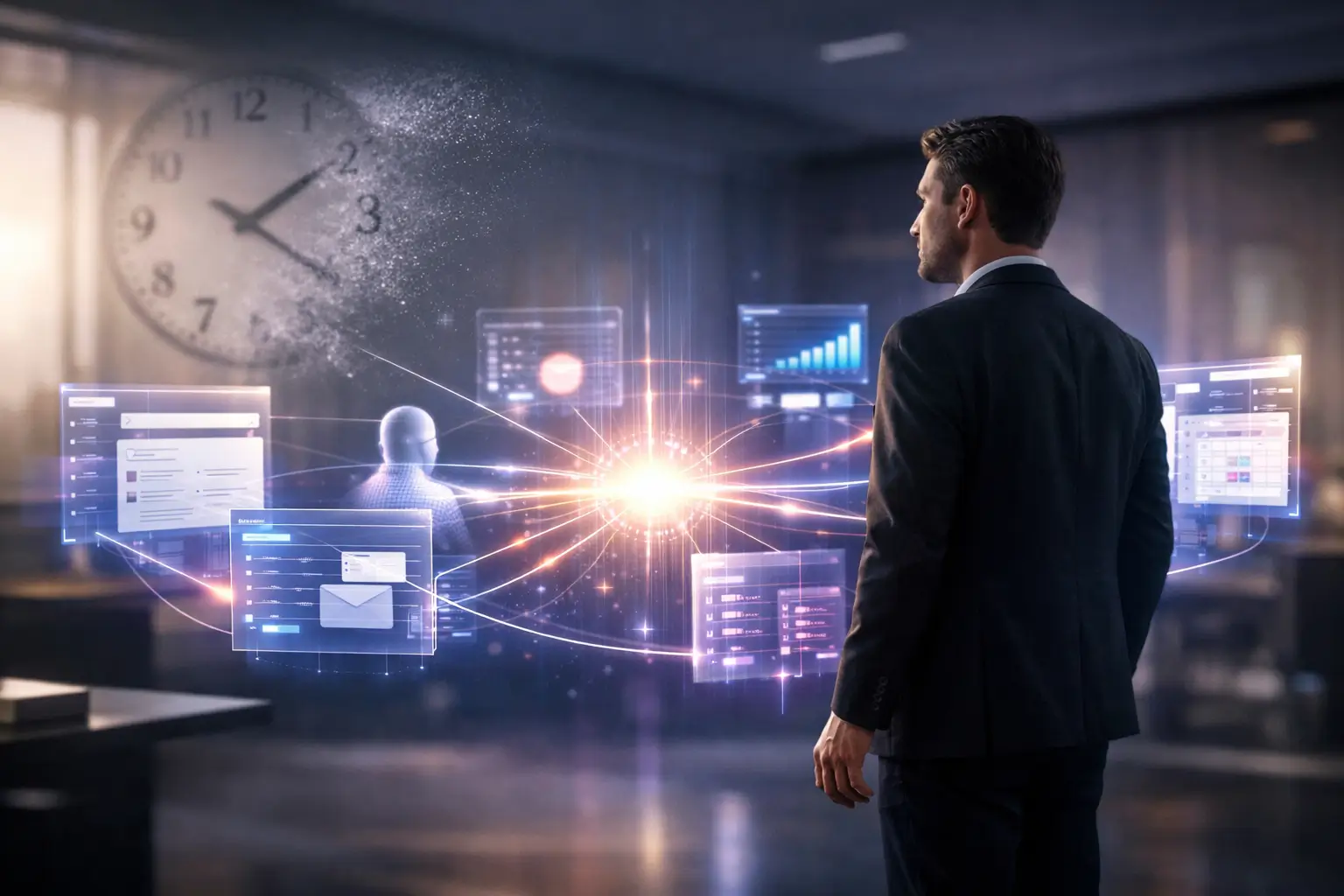

Think back to 2023. We were all captivated by the novelty of “chatting” with AI. We marveled at how ChatGPT could draft a poem or summarize a PDF. But as we navigate through 2026, that era is now widely seen as the early interface phase of the AI revolution. Today, the conversation has shifted. We are no longer just talking to AI; we are deploying Agentic AI—systems designed not just to respond, but to execute autonomously.
The traditional “40-hour work week” is undergoing a profound structural evolution. This isn’t because jobs are simply vanishing, but because the execution layer of work has been radically compressed. We have moved from Generative AI (the thinker) to Agentic AI (the doer). If you are still manually prompting a chatbot for every step of your workflow, you’re likely operating behind the current frontier. Here is how Agentic AI is reclaiming our time by amplifying human strategy.
The Great Paradigm Shift: From Chatbots to “Do-bots”
In the early days of generative models, the human was the constant “driver.” You had to provide the prompt, verify the output, copy-paste the data, and execute the final action yourself. In 2026, that paradigm has flipped. Agentic AI systems are inherently goal-oriented. Instead of a command like “Write an email to my client,” you now define a high-level objective: “Onboard this new client, synchronize their billing profile, and schedule the kickoff meeting based on cross-team availability.”
The defining factor is autonomy. Agentic AI can reason through a complex goal, decompose it into sub-tasks, interact with external tools (such as CRMs, Slack, or ERP systems), and navigate unexpected hurdles without requiring a human “hand-hold” at every interval. This isn’t a mere productivity hack; it represents the emergence of a true digital workforce.
Multi-Agent Systems (MAS): Orchestrating the “Digital Swarm”
The true catalyst for change in 2026 isn’t a single monolithic AI model. It is the rise of Multi-Agent Systems (MAS). Imagine a “Digital Swarm” of specialized agents working in perfect sync. In practice, this is already showing up in marketing operations, customer support automation, and complex internal reporting pipelines. For a modern professional, the work week is no longer drained by coordination because specialized agents handle the segments:
- Researcher Agent: Continuously monitors market trends and competitor shifts 24/7.
- Creator Agent: Generates high-fidelity drafts and visual assets based on real-time data.
- Analyst Agent: Measures performance metrics and suggests immediate tactical pivots.
- Manager Agent (Orchestrator): Aligns all agents toward the primary goal and prepares high-level summaries for human review.
By delegating these execution loops to AI swarms, professional workflows that once required forty hours of manual labor are being compressed into hours of strategic oversight.
The Backbone of 2026: Interoperability and MCP
This leap in capability was made possible by standardized protocols, specifically the Model Context Protocol (MCP). This protocol allows AI systems to interact directly with software tools across your entire stack. Whether it’s a local database or a cloud-based project management suite, agents now have the digital “hands” required to pull data, update records, and execute actions across different platforms.
In 2026, software is no longer just a tool for humans; it is an agent-ready environment. This seamless integration is what enables AI to manage heavy workloads—it lives and breathes inside the systems where the actual work happens.
Trust and E-E-A-T: The Human Handshake
As we integrate these autonomous systems, the principles of E-E-A-T (Experience, Expertise, Authoritativeness, and Trustworthiness) have never been more critical. For a business to allow AI to handle its core operations, “Governance-as-Code” is essential. We have moved toward a model of strategic delegation, where control is codified and oversight is intentional.
While AI handles the execution, high-impact decisions—such as capital allocation, legal approvals, or brand-defining creative choices—still require a “Human Handshake.” Early industry benchmarks suggest that companies adopting agentic orchestration are seeing 30–50% faster operational cycles. This isn’t about removing humans; it’s about freeing them from the friction of execution.
Redefining Your Career: From Worker to Orchestrator
With AI compressing the execution of a 40-hour work week, the role of the professional is being elevated. The most successful individuals in 2026 have embraced the title of “AI Orchestrator.”
Your value is no longer defined by the manual execution of tasks, but in defining intent, designing systems, and auditing outcomes. The work week is evolving from a model of “grind and repeat” into a model centered on leverage, high-level decision-making, and pure human creativity—the elements that AI, for all its speed, cannot replicate with authentic soul.
The Bottom Line
Agentic AI is the fulfillment of the promise made during the first wave of generative AI. It is transitioning the digital world from a “chat” interface to an “action” interface. For publishers, creators, and business leaders, this represents a historic shift. The 40-hour work week is not disappearing; it is being redefined into something far more meaningful, centered on human ingenuity rather than repetitive digital execution.
🛠 Deep Dive: Beyond Chatbots: 7 Agentic AI Tools Actually Doing Work in 2026







1 comment