
Beyond Chatbots: What is Agentic AI?
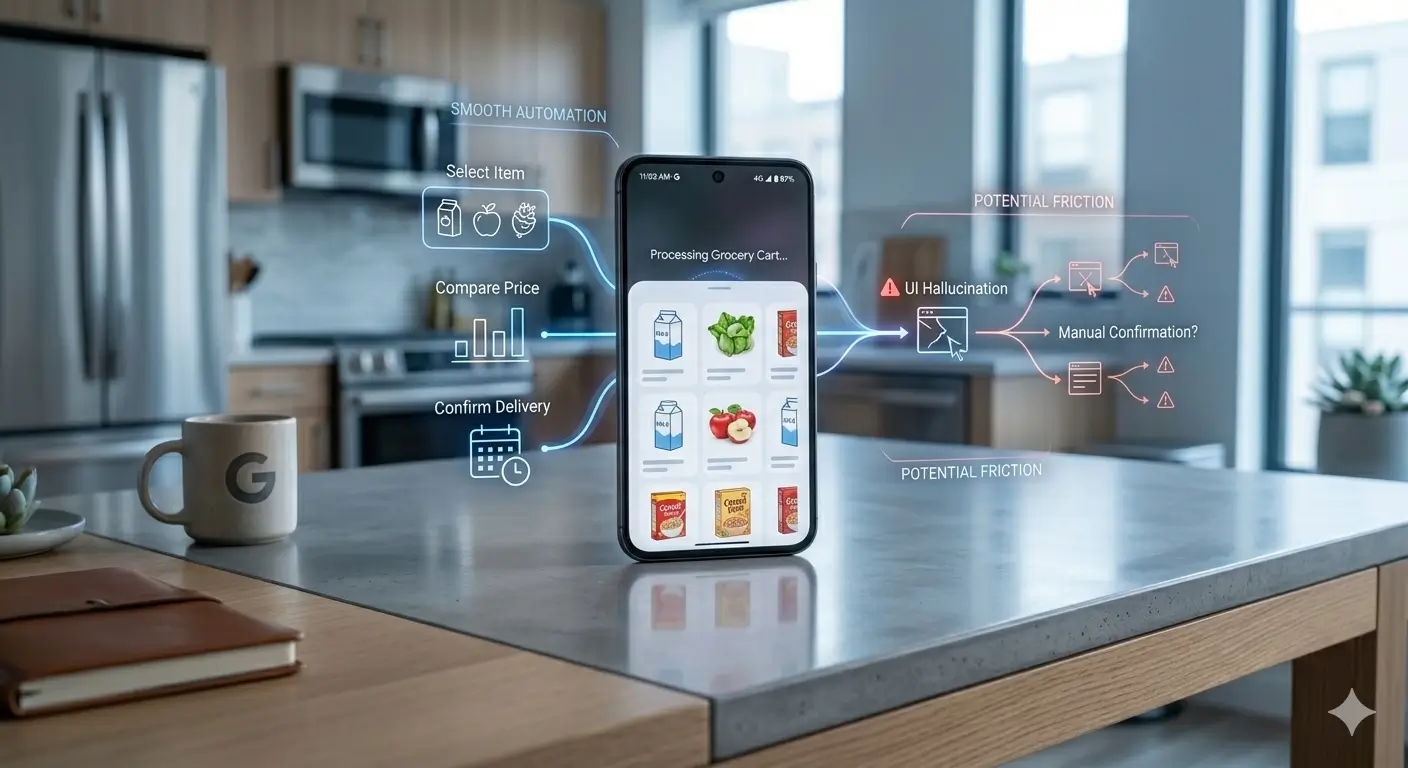
We are officially moving out of the Generative AI era and into the Early Adopter Phase of autonomous agents. Unlike previous versions of Gemini that merely summarized emails, the Gemini 3.1 Flash Live on the Pixel 10 is designed to take action. It uses a specialized Accessibility API Sandbox—a controlled layer that allows the AI to “read” buttons and forms on your screen—to navigate third-party apps just like a human user would.
However, users should view this as an “AI Intern” phase. It is 80% of the way toward full autonomy, but that final 20% still requires significant human oversight to prevent errors in complex workflows.
The Engine: Tensor G5 and the TSMC Transition
To power these local agents, Google has finally moved the Tensor G5 to TSMC’s 3nm process. This is a critical hardware milestone that addresses the thermal issues of the past. By prioritizing INT8 operations (the mathematical language AI uses to think), the G5 provides a significant boost in on-device processing power.
| Technical Metric | Tensor G4 (Old) | Tensor G5 (New) |
|---|---|---|
| Architecture | Samsung 4nm | TSMC 3nm (Custom) |
| AI Execution Model | Cloud-Dependent | On-Device Priority (Hybrid) |
| Processing Efficiency | Baseline | Estimated 40-50% Higher in AI Tasks |
The Latency Paradox: While on-device processing reduces conversational latency (Gemini responds almost instantly), complex third-party workflows—like checking stock at multiple retailers—can still introduce delays as the AI “scans” app interfaces. It is faster than a human, but not yet instantaneous.
Real-World Friction: The Cost of Failure
The most important part of the Pixel 10 story isn’t just what it can do, but what happens when it fails. UI Hallucination remains a genuine risk. If an app updates its layout, the AI might misinterpret a “Cancel” button for a “Confirm” button.
- Financial Risk: Potential for duplicate purchases if the AI misses a loading screen confirmation.
- Logistical Errors: Setting a delivery for “6 PM tomorrow” instead of “6 PM today” due to conversational nuance.
To counter this, Google has implemented Biometric Handshakes. No transaction—financial or data-sensitive—can be finalized without a physical fingerprint or face unlock. This “Human-in-the-loop” guardrail is essential for building trust in an autonomous system.
The Competitive Landscape: Google vs. Apple
The Pixel 10 takes a more aggressive, “open-web” philosophy compared to Apple Intelligence. Apple relies on structured “App Intents,” which are highly stable but limited only to apps that developers have specifically optimized. Google’s approach with the Pixel 10 is to try and navigate any app, optimized or not. This makes the Pixel 10 more versatile for power users, whereas Apple remains the choice for those who value polished, predictable consistency.
Conclusion: The Intern in Your Pocket
The Google Pixel 10 is a brave first step into the agentic era. It successfully transitions the smartphone from a tool we use to a partner that works for us. While it isn’t yet the “CEO” of your digital life—requiring occasional correction and oversight—it is the smartest “intern” technology has ever produced. For those willing to navigate the early hurdles of AI automation, the Pixel 10 is the definitive hardware of 2026.
🛠 Deep Dive: How to Build a Custom GPT for Personal Finance: A Step-by-Step Guide for 2026







1 comment