
Introduction: A Counterintuitive Economic Moment
The United States is experiencing a striking economic contradiction. Artificial intelligence is now estimated to account for nearly 60% of incremental GDP growth, yet headline productivity statistics remain stubbornly flat. Policymakers, investors, and executives are asking the same question: how can an economy powered by the most transformative technology in decades appear so unproductive on paper?
This tension, increasingly referred to as the AI GDP paradox, echoes earlier technological transitions—from electrification to the internet—where economic measurement lagged real-world impact. However, the scale, speed, and concentration of AI’s influence make this moment distinct. Understanding the paradox requires unpacking how GDP is measured, where AI value is actually created, and why productivity metrics are failing to capture the transformation underway.
Understanding the AI Contribution to GDP Growth
How Economists Attribute 60% of Growth to AI
The claim that AI drives roughly 60% of recent U.S. growth does not imply that robots or algorithms directly produce more than half of all output. Instead, it reflects marginal contribution. Over the last several years, much of the acceleration in corporate profits, capital expenditure, equity valuations, and investment flows has been concentrated in AI-related sectors.
These include:
- Cloud infrastructure and hyperscale data centers
- Semiconductor design and manufacturing
- AI software platforms and enterprise automation tools
- Digital advertising, personalization, and recommendation engines
When economists decompose growth, they increasingly find that without AI-driven sectors, overall expansion would be materially weaker.
Capital Deepening, Not Labor Expansion
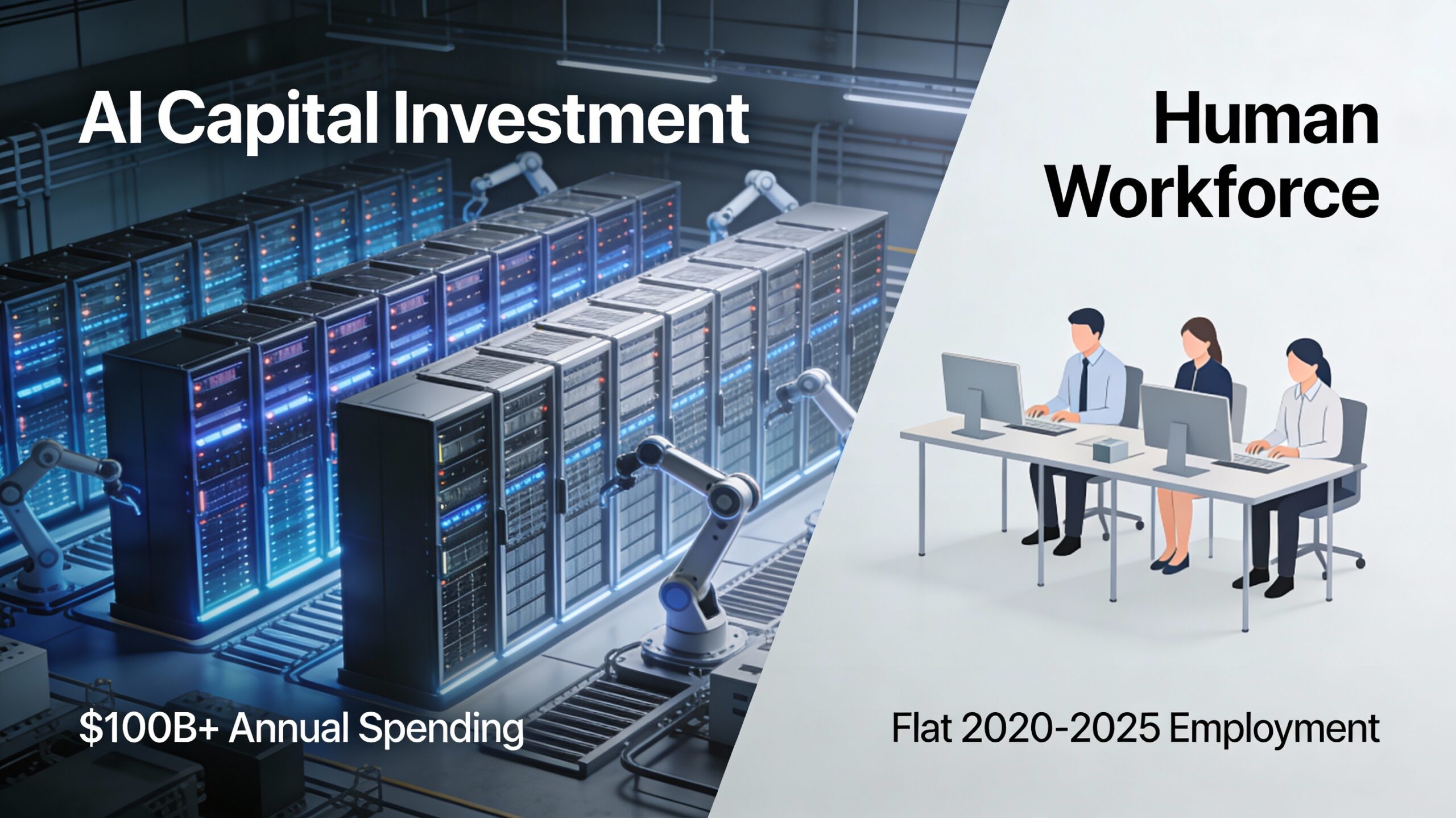
AI-driven growth is overwhelmingly capital-intensive. Massive investments in GPUs, data centers, and proprietary models increase output without proportionally increasing employment. GDP rises because firms invest and earn higher margins, not because more workers are producing more goods per hour.
This distinction is critical. GDP can grow even when labor productivity—output per worker or per hour—appears stagnant.
Why Productivity Metrics Are Falling Behind
The Limits of Traditional Productivity Measurement
Productivity statistics were designed for an industrial economy. They struggle to measure value creation in a digital, intangible, and service-heavy landscape. AI exacerbates these weaknesses.
Key blind spots include:
- Quality improvements: AI-enhanced services are often better, faster, or more accurate, but these gains rarely register as increased output.
- Free or bundled services: Many AI tools are embedded in existing products at no explicit price, contributing consumer surplus without boosting measured GDP.
- Internal efficiency gains: AI frequently improves decision-making, forecasting, and error reduction inside firms—benefits that do not translate cleanly into higher recorded output.
The Intangible Asset Problem
Modern firms increasingly invest in intangible assets such as data, models, training pipelines, and organizational know-how. While capital expenditure on factories and machines is well captured, spending on AI training and data curation is often treated as an expense rather than long-term investment.
As a result, productivity statistics understate the capital stock and overstate costs, mechanically depressing measured productivity growth.
The Concentration Effect: Growth Without Broad Gains
AI’s Winner-Take-Most Economics
AI markets exhibit strong economies of scale. Large firms with access to vast datasets, compute resources, and distribution networks capture outsized returns. This leads to high aggregate growth with narrow distribution.
A small number of companies generate extraordinary profits and market capitalization gains, lifting GDP and equity indices, while the median firm sees modest improvement.
Why the Median Worker Feels Left Behind
For many workers, AI does not yet translate into higher wages or reduced workloads. In some cases, it increases performance expectations without proportional compensation. From a productivity perspective, gains accrue to capital owners faster than to labor.
This divergence reinforces the perception of stagnation even as headline growth accelerates.
AI as a Measurement Problem, Not a Performance Failure
Lessons From Past Technology Transitions
The AI GDP paradox mirrors earlier historical episodes:
- Electrification boosted factory efficiency decades before productivity statistics reflected it.
- Personal computers entered offices in the 1980s, yet productivity growth did not surge until the late 1990s.
- The internet initially appeared to distract workers before reorganizing entire industries.
In each case, the technology required complementary investments—skills, workflows, institutions—before productivity gains became visible.
Organizational Lag and Process Inertia
AI tools are often deployed as add-ons rather than catalysts for redesign. Firms layer AI on top of legacy processes instead of reengineering workflows around it. This limits near-term productivity impact while still increasing costs and complexity.
True productivity growth requires structural change, not just technological adoption.
Where AI Growth Actually Shows Up
Profits, Not Output Volumes
AI’s most visible impact is on margins. Better pricing algorithms, targeted marketing, predictive maintenance, and automation reduce costs and increase revenue efficiency. Firms earn more from the same level of output.
GDP captures profits, but productivity metrics focus on physical or service output per labor unit. When gains are margin-driven, productivity appears flat.
Financial Markets as Early Indicators
Equity markets have reacted far more strongly to AI than productivity statistics. Valuations reflect expectations of future cash flows, not current output. In this sense, markets may be registering AI’s impact earlier than official economic data.
This disconnect fuels skepticism but may simply reflect different measurement horizons.
The Role of AI-Induced Demand Shifts
Automation That Expands Demand
Contrary to fears of demand destruction, AI often creates new demand by lowering costs and enabling new products. However, this demand is frequently digital, customized, and service-oriented—areas hardest to quantify.
Examples include:
- Personalized media and entertainment
- AI-assisted professional services
- On-demand, algorithmically optimized logistics
These activities generate value without proportionate increases in measured output.
Consumer Surplus Remains Invisible
When AI improves convenience, speed, or accuracy without raising prices, consumers benefit. Yet GDP and productivity metrics largely ignore consumer surplus. The result is real welfare gains without statistical recognition.
Policy Implications of the AI GDP Paradox
Rethinking Productivity Measurement
Governments may need to modernize economic statistics to account for:
- Intangible capital formation
- Quality-adjusted services
- Digital public goods powered by AI
Without reform, policymakers risk misdiagnosing economic health and underinvesting in complementary infrastructure.
Labor Market Adjustment Over Time
Productivity gains may emerge as AI reshapes job roles rather than eliminates them. Augmented workers, new occupational categories, and redesigned workflows take time to mature.
Short-term stagnation does not preclude long-term acceleration.
When the Paradox May Resolve
The Tipping Point for Measured Productivity
Productivity growth is likely to materialize when three conditions align:
- Widespread organizational redesign around AI-native processes
- Broad diffusion of AI beyond frontier firms
- Human capital adaptation, including training and role redefinition
At that point, output per worker should rise visibly, closing the gap between GDP growth and productivity data.
A Delayed but Powerful Payoff
If history is a guide, the productivity surge may arrive suddenly after years of apparent stagnation. The paradox, in retrospect, may look less like a failure and more like a gestation period.
Conclusion: Interpreting the AI Economy Correctly
The AI GDP paradox is not evidence that artificial intelligence is overhyped or economically hollow. Rather, it exposes the limits of legacy measurement frameworks in a rapidly transforming economy.
AI is driving growth through capital deepening, margin expansion, and intangible value creation—channels that GDP captures imperfectly and productivity statistics capture poorly. Until institutions, firms, and metrics adapt, the disconnect will persist.
For decision-makers, the critical insight is this: stagnating productivity numbers do not imply stagnating progress. They signal that the economy is changing faster than our tools for understanding it.
As AI diffusion deepens and organizational transformation accelerates, today’s paradox may become tomorrow’s productivity renaissance.