
Introduction: The AI Paradox Comes Into Focus
For much of the 2020s, artificial intelligence has presented a confounding contradiction. Investment has surged, model capabilities have improved at extraordinary speed, and AI systems are now embedded across software, media, and enterprise workflows. Yet, at the macroeconomic level, productivity growth, wages, and measurable output have not risen in proportion to the hype. This disconnect—often labeled the “AI paradox”—has become a central theme in economic, policy, and technology debates.
By 2026, however, many analysts expect this paradox to resolve. Not because AI development slows, but because its economic effects finally become visible, durable, and broadly distributed. The transition underway is not from innovation to stagnation, but from experimentation to extraction of value. In other words, the AI economy is moving from hype to harvest.
This article examines why 2026 is widely predicted to mark that inflection point, analyzing the structural, organizational, and measurement changes that convert AI capability into real economic impact.
Understanding the AI Paradox
What Is the AI Paradox?
The AI paradox refers to the gap between rapid advances in AI capability and the lack of corresponding gains in productivity and economic statistics. Despite breakthroughs in large language models, computer vision, and autonomous systems, traditional indicators such as GDP per worker and total factor productivity have remained relatively flat.
This phenomenon is not unprecedented. Similar paradoxes accompanied earlier general-purpose technologies, including electricity, personal computing, and the internet. In each case, transformative potential existed long before institutions, processes, and skills adapted enough to realize it.
Why the Paradox Persisted Through 2024–2025
Several factors contributed to the delayed payoff:
-
Pilot-heavy adoption: Many organizations experimented with AI without deploying it at scale.
-
Workflow mismatch: AI tools were layered onto legacy processes rather than reshaping them.
-
Measurement blind spots: AI-generated value often appeared as quality improvements or cost avoidance, not captured in standard metrics.
-
Human bottlenecks: Decision rights, compliance, and trust remained human-centric, limiting automation.
By late 2025, these constraints began to weaken simultaneously.
Why 2026 Is the Tipping Point
The Shift From Tools to Systems
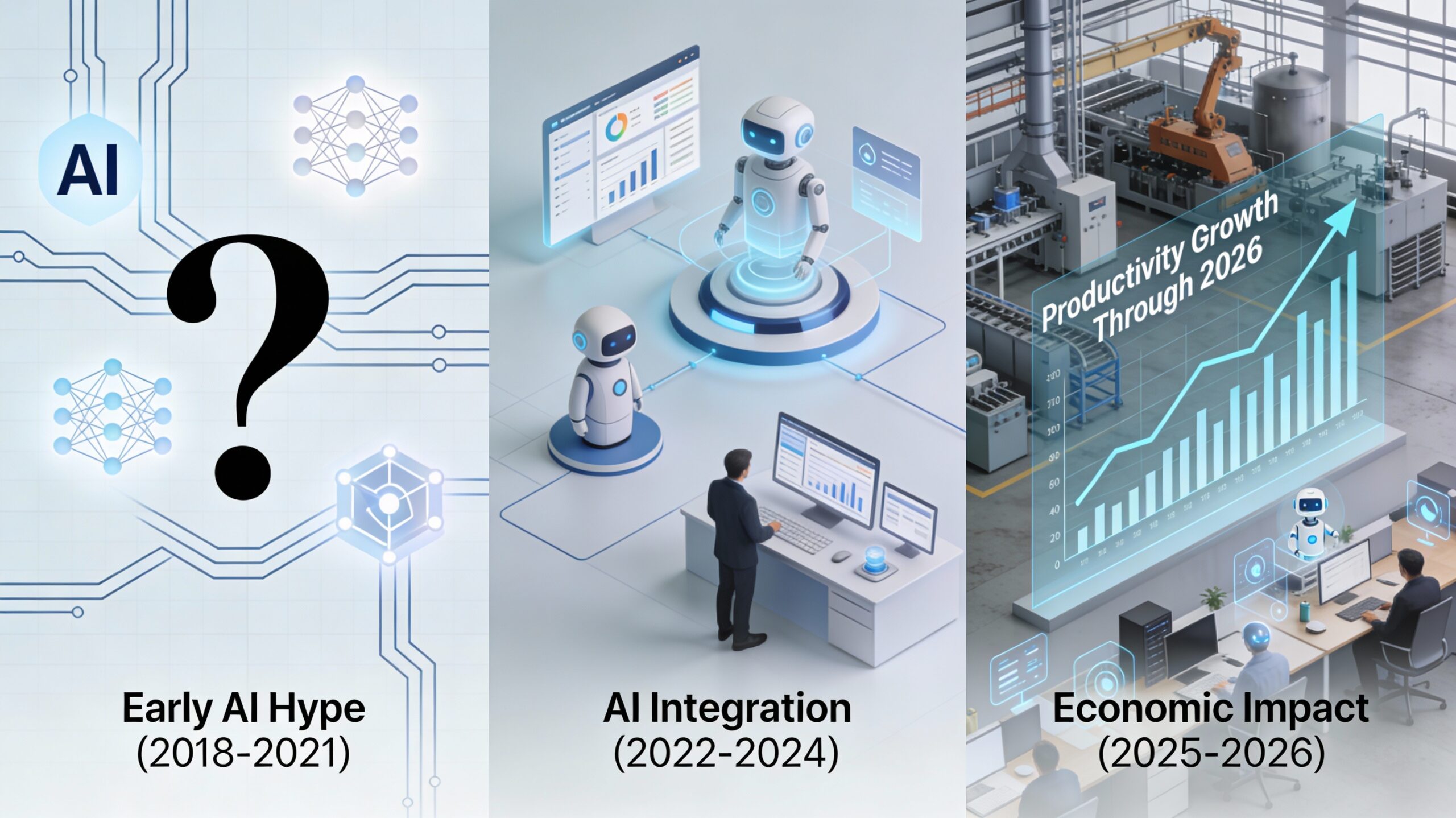
Between 2022 and 2024, AI primarily existed as discrete tools: chat interfaces, copilots, and plugins. By contrast, 2026 marks the maturation of AI as a system-level technology.
Enterprises are increasingly deploying AI across entire value chains—linking data ingestion, decision-making, execution, and feedback loops. Agentic architectures allow models not just to advise humans, but to act within defined boundaries, coordinating tasks across departments.
This systemic integration is essential for productivity gains to materialize.
Organizational Redesign Catches Up
Historically, productivity gains lag technological innovation because organizations must redesign roles, incentives, and governance. In 2026, several organizational shifts converge:
-
Flatter structures as AI absorbs routine analytical and coordination work.
-
Outcome-based teams replacing role-based silos.
-
AI-native processes designed around automation first, with humans handling exceptions.
Once firms stop treating AI as an add-on and start building around it, efficiency improvements become structural rather than experimental.
Capital Deepening and Compute Abundance
Compute Constraints Begin to Ease
One reason AI impact lagged was compute scarcity. Training and inference costs limited deployment to high-value use cases. By 2026, expanded data center capacity, specialized chips, and more efficient models significantly reduce marginal compute costs.
This compute abundance enables:
-
Always-on AI systems rather than episodic usage.
-
Deeper inference embedded into operational processes.
-
Economically viable automation for mid-value tasks.
As with electrification, when power becomes cheap and reliable, usage patterns fundamentally change.
AI Becomes a Form of Capital
Economists increasingly treat AI not merely as software, but as a capital asset—analogous to machinery or infrastructure. Firms invest upfront in models, data pipelines, and integration, then amortize gains over time through higher output per worker.
By 2026, accounting practices and internal metrics better reflect this reality, reinforcing investment cycles.
The Measurement Problem Finally Improves
Intangible Value Becomes Visible
A major contributor to the AI paradox has been measurement failure. AI often improves:
-
Accuracy
-
Speed
-
Customization
-
Risk reduction
These benefits enhance consumer surplus and business resilience without immediately raising prices or headcount. As statistical agencies and firms refine methods for valuing intangibles, AI’s contribution becomes more visible.
Lagging Indicators Catch Up
Macroeconomic data is inherently backward-looking. Productivity gains realized in late 2025 may only appear in official statistics by mid-to-late 2026. This timing alone explains much of the perceived delay.
Once multiple quarters of AI-driven efficiency compound, the signal becomes undeniable.
Labor Markets Reach a Rebalancing Phase
Task Transformation, Not Job Elimination
By 2026, the labor market narrative around AI shifts from displacement anxiety to task reallocation. AI absorbs repetitive cognitive work, while human roles concentrate on:
-
Judgment and oversight
-
Relationship management
-
Creative synthesis
-
Strategic decision-making
This rebalancing increases output per worker even if total employment remains stable.
Wage Polarization Stabilizes
Early AI adoption disproportionately benefited high-skill workers. As AI tools become standardized and embedded into workflows, productivity gains spread across mid-skill roles as well. This diffusion supports broader wage growth and reduces the perception that AI benefits only a narrow elite.
Sector-Level Breakthroughs Drive Aggregate Gains
Professional Services Finally Scale
Law, consulting, accounting, and finance resisted automation longer than manufacturing or logistics. By 2026, AI-native firms in these sectors operate at radically different cost and speed profiles.
When sectors representing a large share of GDP unlock productivity gains, macro indicators respond quickly.
Manufacturing and Supply Chains Go End-to-End
AI-driven design, forecasting, and quality control are now integrated across manufacturing lifecycles. Rather than optimizing isolated steps, firms optimize entire systems—from R&D to delivery—amplifying gains.
Regulation and Trust Mature
Clearer Rules Reduce Friction
Regulatory uncertainty slowed deployment in critical sectors such as healthcare, finance, and government. By 2026, clearer AI governance frameworks reduce legal risk and compliance costs.
This predictability encourages scaled adoption rather than cautious experimentation.
Trust Enables Automation
Trust is an economic variable. As AI systems demonstrate reliability and auditability, organizations allow them greater autonomy. The resulting reduction in human oversight costs directly boosts productivity.
Lessons From Past General-Purpose Technologies
History Repeats, With a Lag
Electricity took decades to transform factories because layouts had to change. Computers delivered productivity gains only after businesses reorganized around them. AI follows the same pattern—compressed into a shorter timeline.
The paradox was never evidence that AI “didn’t work,” but that transformation requires complementary changes.
2026 as the Inflection, Not the End State
Resolution of the AI paradox does not mean the end of AI progress. It marks the point where benefits become systemic and compounding, rather than speculative.
What “Harvest” Looks Like in Practice
For Businesses
-
Sustained margin expansion driven by automation.
-
Faster innovation cycles with fewer employees.
-
Data and models treated as core infrastructure.
For Economies
-
Rising productivity statistics after years of stagnation.
-
Improved public-sector efficiency.
-
Stronger linkage between technological progress and living standards.
For Policymakers
-
Evidence-based AI policy grounded in measurable outcomes.
-
A shift from fear mitigation to growth enablement.
Conclusion: From Promise to Proof
The AI paradox has dominated discourse because expectations ran ahead of institutions. By 2026, that gap narrows. Not because AI hype disappears, but because its value becomes measurable, repeatable, and embedded in how work is done.
From tools to systems, from pilots to platforms, and from invisible gains to recorded growth, the transition from hype to harvest is underway. The year 2026 is not when AI suddenly starts working—it is when the world finally starts counting what AI has already begun to deliver.