
Introduction: The New Shape of Economic Growth
By 2026, artificial intelligence has moved decisively from experimentation to infrastructure. Across advanced and emerging economies alike, AI systems now sit inside core business processes: forecasting demand, optimizing logistics, automating compliance, accelerating research, and coordinating complex workflows across enterprises. The result is a visible acceleration in productivity growth after years of stagnation. Yet this same period has been marked by labor market anxiety, job redesign, and uneven employment outcomes.
This apparent contradiction—rising productivity alongside profound job disruption—defines the AI-driven global economy of 2026. Understanding why these trends coexist is essential for policymakers, business leaders, and workers navigating the next phase of economic transformation.
The Productivity Revival: Why AI Is Finally Moving the Needle
From Isolated Tools to Integrated Systems
Earlier waves of enterprise AI focused on narrow applications: chatbots, recommendation engines, or pilot automation projects. Their economic impact was limited and often invisible at the macro level. By 2026, the shift to integrated AI systems has changed that equation.
Firms now deploy AI across entire value chains rather than single tasks. Data pipelines feed autonomous agents that coordinate procurement, production scheduling, pricing, and customer engagement in near real time. These systems reduce friction, compress decision cycles, and eliminate coordination costs that previously constrained output.
Intangible Capital at Scale
Productivity gains in 2026 are increasingly driven by intangible assets: proprietary data, trained models, optimized workflows, and organizational know-how encoded into software. Unlike physical capital, these assets scale rapidly and improve through use.
A single AI model can support thousands of decisions per hour across geographies, enabling firms to do more with the same—or even fewer—inputs. Traditional productivity metrics struggled to capture this value in earlier years, but by 2026 the aggregate effects are large enough to appear in national accounts.
Sectoral Impact Is Broadening
Initially concentrated in technology and finance, AI-driven productivity gains have spread into manufacturing, healthcare, logistics, energy, and professional services. Factories use AI for predictive maintenance and adaptive production. Hospitals deploy AI-assisted diagnostics and scheduling. Law, accounting, and consulting firms automate research and document-intensive work.
This diffusion explains why productivity growth is no longer confined to a handful of digital leaders but is showing up across entire economies.
Why Jobs Are Changing, Not Disappearing
Task Automation Versus Job Automation
A central misconception in AI economics is the idea that jobs are automated wholesale. In practice, AI automates tasks, not occupations. Most roles consist of multiple activities, only some of which are suitable for automation.
By 2026, AI handles routine cognitive work—data entry, basic analysis, report drafting, scheduling—freeing human workers to focus on judgment, creativity, relationship management, and oversight. Jobs are being reconfigured rather than eliminated outright.
The Rise of Hybrid Roles
One defining feature of the 2026 labor market is the emergence of hybrid roles that combine domain expertise with AI fluency. Examples include:
- Financial analysts who supervise AI forecasting models
- Marketing professionals who orchestrate AI-driven content and personalization systems
- Engineers who collaborate with generative design tools
- Operations managers who oversee autonomous supply chains
These roles did not exist in their current form five years ago, yet they are now central to organizational performance.
Job Polarization Accelerates
While total employment has proven more resilient than early forecasts suggested, job polarization has intensified. High-skill roles that complement AI have seen rising wages and demand. Low-skill service roles that require physical presence—care work, hospitality, maintenance—remain relatively stable.
Middle-skill, routine white-collar jobs face the greatest pressure. Clerical, administrative, and transactional roles are shrinking as AI systems absorb their core functions. This shift explains why employment disruption can coexist with strong productivity growth.
Global Divergence: Winners and Laggards in the AI Economy
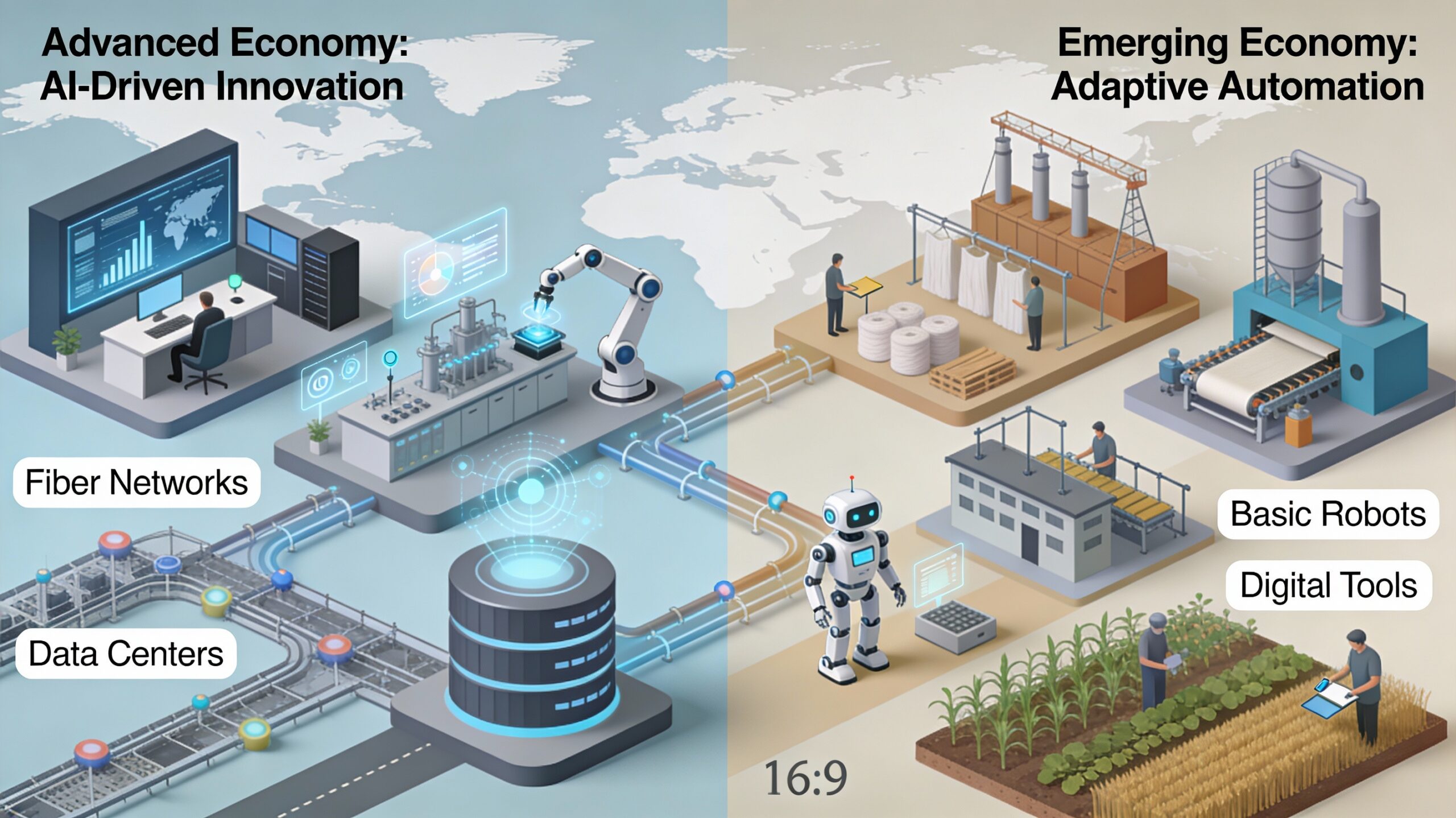
Advanced Economies: Scaling Efficiency
In advanced economies, AI adoption has helped offset aging populations and labor shortages. Productivity gains allow firms to maintain output despite slower workforce growth. Countries with strong digital infrastructure, deep capital markets, and flexible labor systems have moved fastest.
However, these gains are unevenly distributed. Regions that fail to reskill workers or modernize institutions face rising inequality and political tension.
Emerging Markets: Opportunity and Risk
For emerging economies, AI presents a dual challenge. On one hand, AI lowers barriers to entry in areas such as software development, design, and services exports. Small firms can now compete globally using AI-augmented labor.
On the other hand, traditional development pathways based on labor-intensive manufacturing are under pressure. If automation reduces demand for low-cost labor, countries that rely heavily on export manufacturing may struggle unless they move up the value chain.
The Role of Digital Sovereignty
By 2026, control over data, compute infrastructure, and AI platforms has become a strategic economic concern. Nations that depend heavily on foreign AI systems risk losing leverage over productivity gains and labor market outcomes. As a result, policies around cloud infrastructure, data localization, and domestic AI capability increasingly shape economic competitiveness.
Corporate Strategy in 2026: Productivity as Organizational Design
AI as a Management Technology
AI is no longer just a technology investment; it is a management system. Firms that succeed in 2026 redesign decision rights, workflows, and accountability around AI capabilities. This often means flatter organizations, faster feedback loops, and greater emphasis on cross-functional coordination.
Productivity gains depend less on the sophistication of individual models and more on how effectively humans and machines collaborate.
Measuring Output in an AI-Driven Firm
Traditional performance metrics struggle to capture AI-driven value creation. Output increases may appear as faster cycle times, fewer errors, higher customization, or improved resilience rather than higher headcount or physical throughput.
Leading firms have developed internal metrics that track AI contribution to revenue, margin expansion, and risk reduction, providing clearer visibility into productivity improvements.
Labor Policy and Workforce Adaptation
Reskilling at Economic Scale
The pace of job change in 2026 has made incremental training insufficient. Governments and firms are shifting toward continuous, modular reskilling systems aligned with real-time labor market needs.
Successful programs focus on:
- AI literacy for non-technical roles
- Domain-specific AI supervision skills
- Human strengths such as critical thinking and communication
Reskilling is increasingly treated as core economic infrastructure rather than a social safety measure.
Rethinking Social Contracts
As job tenure shortens and career paths become less linear, pressure is mounting to update social safety nets. Portable benefits, wage insurance, and lifelong learning accounts are gaining traction as ways to manage transition risk without slowing innovation.
The countries that adapt fastest are better positioned to sustain political support for AI-driven growth.
Why Productivity Gains Feel Invisible to Workers
The Distribution Problem
One reason AI-driven productivity gains generate public skepticism is that benefits are unevenly distributed. Profits accrue quickly to firms that control data, platforms, and capital, while wage growth lags for many workers.
This creates a perception gap: economies appear to be growing, but individual households may not feel better off.
Adjustment Lags in Labor Markets
Labor markets adjust more slowly than technology. Workers displaced from declining roles do not immediately move into emerging ones, even when opportunities exist. Geographic immobility, credential barriers, and skills mismatch all contribute to temporary dislocation.
These lags explain why job anxiety can rise even as overall employment remains stable.
The Outlook Beyond 2026
From Transition to Transformation
By 2026, the global economy is still in transition rather than equilibrium. Productivity gains from AI are accelerating, but institutional adaptation—education, regulation, labor policy—lags behind.
Over the next decade, the central challenge will be aligning these systems so that AI-driven growth translates into broadly shared prosperity.
The Human Advantage Endures
Despite rapid automation, human capabilities remain central. Judgment, ethics, creativity, leadership, and empathy are not easily codified. Economies that invest in amplifying these traits alongside AI will capture the greatest long-term value.
Conclusion: A New Economic Balance
AI and the global economy in 2026 are defined by a fundamental rebalancing. Productivity is rising because intelligence itself has become a scalable input. Jobs are changing because the nature of work is being restructured around that new reality.
The challenge is not whether AI will shape economic outcomes—it already has—but whether societies can adapt fast enough to ensure that rising productivity leads to opportunity rather than instability. Those that succeed will define the next era of global growth.







1 comment