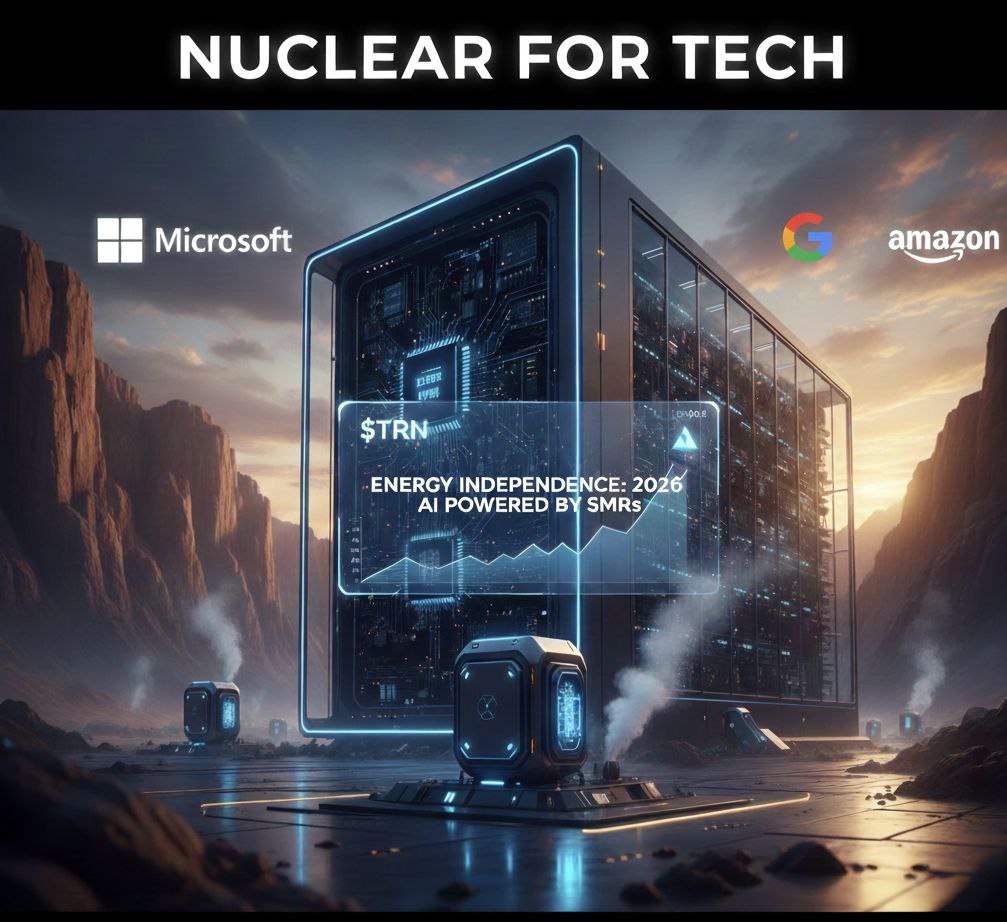

If you’ve been tracking the 2026 financial markets, you’ve likely noticed a strange decoupling. While traditional SaaS (Software as a Service) companies are fighting for survival, the “Big Three”—Microsoft, Google, and Amazon—are hitting all-time highs. The reason? They’ve stopped being mere tech companies and have begun their transformation into private energy utilities. The weapon of choice? Small Modular Reactors (SMRs).
Read Also: Meta’s 2026 Monetization Shift: My Personal Journey with the New Reels Economy
The Invisible Wall: Why the Grid is Failing AI
To understand why a company like Microsoft would want to manage a nuclear reactor, you have to look at the sheer scale of the energy crisis facing Artificial Intelligence. The “Agentic AI” models we are using today in 2026 require ten times the compute power of the GPT-4 era. This isn’t just a slight increase; it’s a structural shift.
Public grids in the US, Europe, and even parts of Asia are ancient. They were built for a world of lightbulbs and washing machines, not for Data Centers that pull as much power as a mid-sized city. In late 2025, we saw several major AI projects stalled simply because the local power companies couldn’t guarantee supply. For Big Tech, waiting for the government to fix the grid is not an option. They need energy sovereignty.
Enter the SMR: The Mini-Reactor Revolution
So, what exactly are these Small Modular Reactors (SMRs) that everyone is talking about? Unlike the massive, sprawling nuclear plants of the 1970s that cost billions and take 20 years to build, SMRs are the “plug-and-play” version of nuclear energy.
- Factory Built: SMRs are manufactured in controlled environments and shipped to the site. This reduces the risk of construction delays—the traditional death sentence of nuclear projects.
- Scalable Power: A single SMR unit typically puts out about 300 megawatts. If an AI cluster grows, you simply add another module. It’s “Compute on Demand” but for the physical world.
- Passive Safety: In 2026, the technology has reached a point where many SMR designs use “natural circulation,” meaning they can shut down safely without human intervention or external power in case of an emergency.
The Financial Angle: Where the Wealth is Moving
From an investment perspective, the 2026 “Nuclear Renaissance” is creating a new class of millionaires. We are seeing a massive rotation of capital out of “Pure AI” startups and into the AI Infrastructure sector. Here is how the wealth is being redistributed:
1. The Uranium Boom
Uranium is the new lithium. As tech giants sign 20-year power purchase agreements (PPAs), the demand for nuclear fuel has reached a fever pitch. Investors who entered the market in 2024 are seeing 300% returns as of this month.
2. The Hardware-Utility Hybrid
Companies like Constellation Energy and NuScale Power are no longer viewed as boring utility stocks. They are being traded like high-growth tech stocks. When Microsoft announced its direct integration with an SMR provider in Virginia earlier this week, the stock market reaction was indistinguishable from a major software launch.
Real-World Impact: How This Affects the Global Economy
It’s not just about stock prices. The shift to nuclear-backed AI is redrawing the map of global influence. We are seeing a “Digital Gold Rush” in regions with stable nuclear regulations. Countries that have embraced SMR technology are seeing a massive influx of tech talent and infrastructure investment, while those clinging to old energy models are facing a “Digital Brain Drain.”
Moreover, the environmental narrative is shifting. For years, AI was criticized for its massive carbon footprint. By anchoring AI development to zero-emission nuclear power, the tech industry is attempting to reclaim the moral high ground in the climate change debate. In 2026, “Green AI” isn’t just a marketing slogan; it’s a nuclear-powered reality.
The Risks: Is the 2026 Hype Justified?
No investment is without risk, and the Silicon-Nuclear fusion is no exception. Skeptics point to the “Nuclear Waste” problem, which remains a political lightning rod. While the SMRs of 2026 are far more efficient than their predecessors, the long-term storage of spent fuel is a challenge that software cannot yet solve.
There is also the risk of over-centralization. If three or four tech giants own the world’s most efficient power sources and the world’s most powerful AI, we are looking at a level of corporate power unprecedented in human history. We aren’t just talking about monopolies; we are talking about Technocracies.
Conclusion: The Path Forward
As we navigate through 2026, the takeaway for every tech enthusiast and financial investor is clear: Watch the power. The companies that win the next decade won’t be the ones with the best algorithms—they will be the ones with the most reliable, sustainable, and independent energy sources.
The era of the “Virtual Tech” is over. We have entered the era of Physical AI. And the heart of that physical world is beating with the power of the atom.