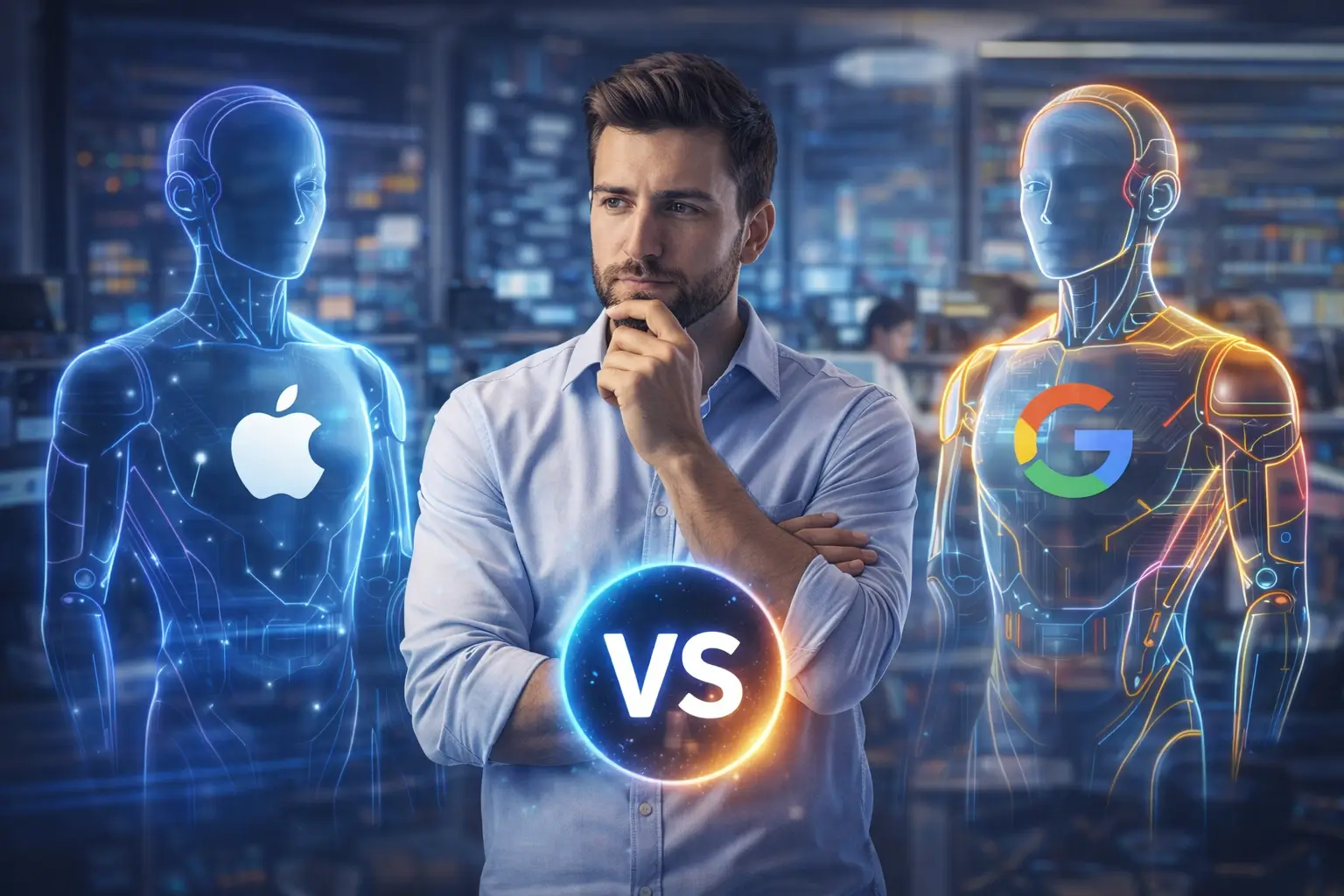
Apple vs. Google: Who is Leading the AI Assistant Race in 2026?
Let’s be honest—the days of asking our phones for the weather or to set a 5-minute timer are long gone. We are now in 2026, and the “AI Assistant” has evolved from a simple voice-activated tool into a proactive digital companion that knows our habits, manages our schedules, and even anticipates our needs before we express them. But as we stand at this technological crossroads, the biggest question for every tech enthusiast and casual user alike remains: Who is actually winning? Apple or Google?
Having tracked the development of Apple Intelligence and Google Gemini over the past two years, I’ve seen a massive shift in how these tech giants approach artificial intelligence. It’s no longer just about who has the smartest chatbot; it’s about who offers the best integration, the most privacy, and the most “human” experience. Let’s dive deep into the 2026 AI showdown.
The Rise of Agentic Workflows: A New Era
Before we compare the two, we need to understand the concept of Agentic Workflows. In 2026, AI isn’t just responding to prompts; it’s acting as an “agent.” This means if you tell your phone, “Book me a flight to Singapore next Tuesday and find a hotel near the tech district,” the AI doesn’t just show you links—it actually researches, compares, and prepares the booking for you. Both Apple and Google have taken very different paths to achieve this.
Apple Intelligence: The Privacy-First Powerhouse
Apple has always played the long game with privacy, and in 2026, that bet is paying off. While Google relies heavily on the cloud, Apple’s strategy is centered around On-Device Processing. This is a game-changer for users who are wary of their personal data being stored on external servers.
Personal Context is Key
What makes Apple’s AI (Siri 2.0) feel so personal is its semantic index. It doesn’t just know “facts”; it knows your facts. It remembers that your daughter’s recital is next Friday, it knows which email contains your flight details, and it can cross-reference your photos to find that specific receipt you need. Because this happens on your device, the speed and security are unparalleled.
The Ecosystem Advantage
If you own an iPhone, Mac, and iPad, Apple’s AI feels like a seamless thread running through them all. The integration with macOS is particularly impressive this year, allowing the AI to perform complex cross-app tasks like “Take the summary of this meeting from Zoom and create a Reminders list for me.”
Google Gemini: The World’s Most Knowledgeable Assistant
If Apple is your personal assistant who knows your house, Google Gemini is the librarian who knows every book ever written. Google’s strength remains its vast information graph. No one can compete with Google when it comes to real-time data from Maps, Search, YouTube, and Workspace.
Multi-Modal Mastery
Google Gemini’s ability to process video, audio, and text simultaneously is its “killer feature.” You can point your camera at a broken bicycle engine, and Gemini will walk you through the repair process in real-time, pulling data from YouTube tutorials and official manuals instantly. This level of multi-modal reasoning is where Google currently holds a slight lead over Apple.
The Cloud Connectivity Edge
While Apple focuses on what’s on your phone, Google focuses on what’s in the world. For researchers, travelers, and students, Gemini is arguably the better tool because its knowledge base is constantly being updated by the entire internet in real-time.
Direct Head-to-Head: The 2026 Comparison Table
| Feature | Apple Intelligence | Google Gemini |
|---|---|---|
| Core Strength | Privacy & Personal Context | Global Knowledge & Multi-modality |
| Processing | Mostly On-Device (Private Cloud) | Primarily Cloud-Based |
| Ecosystem | Highly Closed (Apple Devices only) | Open (Android, iOS App, Web) |
| Best For… | Daily Life & Personal Productivity | Research, Learning & Creative Work |
The “Human” Layer: Which One Feels More Natural?
As someone who uses both daily, there’s a subtle difference in “personality.” Apple’s AI feels like a helpful, quiet butler. It’s out of the way until you need it. Google Gemini, on the other hand, feels more like a proactive collaborator. It suggests things, it pushes information, and it’s much more talkative.
In 2026, the Human-AI collaboration has reached a point where we no longer feel like we are talking to a machine. Both assistants have mastered natural language, meaning you can stumble over your words or change your mind mid-sentence, and they will still understand you perfectly.
The ROI Factor: Why Businesses Care
This isn’t just about fun gadgets. For businesses, the choice between Apple and Google AI affects their bottom line. We’ve seen a massive ROI (Return on Investment) increase for companies that integrate AI agents into their workflows. Whether it’s through Google Workspace’s AI or Apple’s enterprise tools, automating the “busy work” is saving companies hundreds of hours per month.
Conclusion: Who Wins the Race?
So, back to our main question. Who is leading the race? The answer depends entirely on what you value most.
- Choose Apple if your priority is 100% privacy and you want an assistant that knows your personal life deeply without ever compromising your data.
- Choose Google if you need a powerhouse of information, do a lot of research, and want an AI that can pull from the vast knowledge of the internet instantly.
In my opinion, the real winner is the user. In 2026, we are no longer limited by our own bandwidth. With these AI assistants, we are effectively augmenting our intelligence. The race isn’t over, but one thing is certain: AI is no longer a luxury—it’s a necessity.
What do you think? Are you Team Apple or Team Google? Let me know in the comments below!