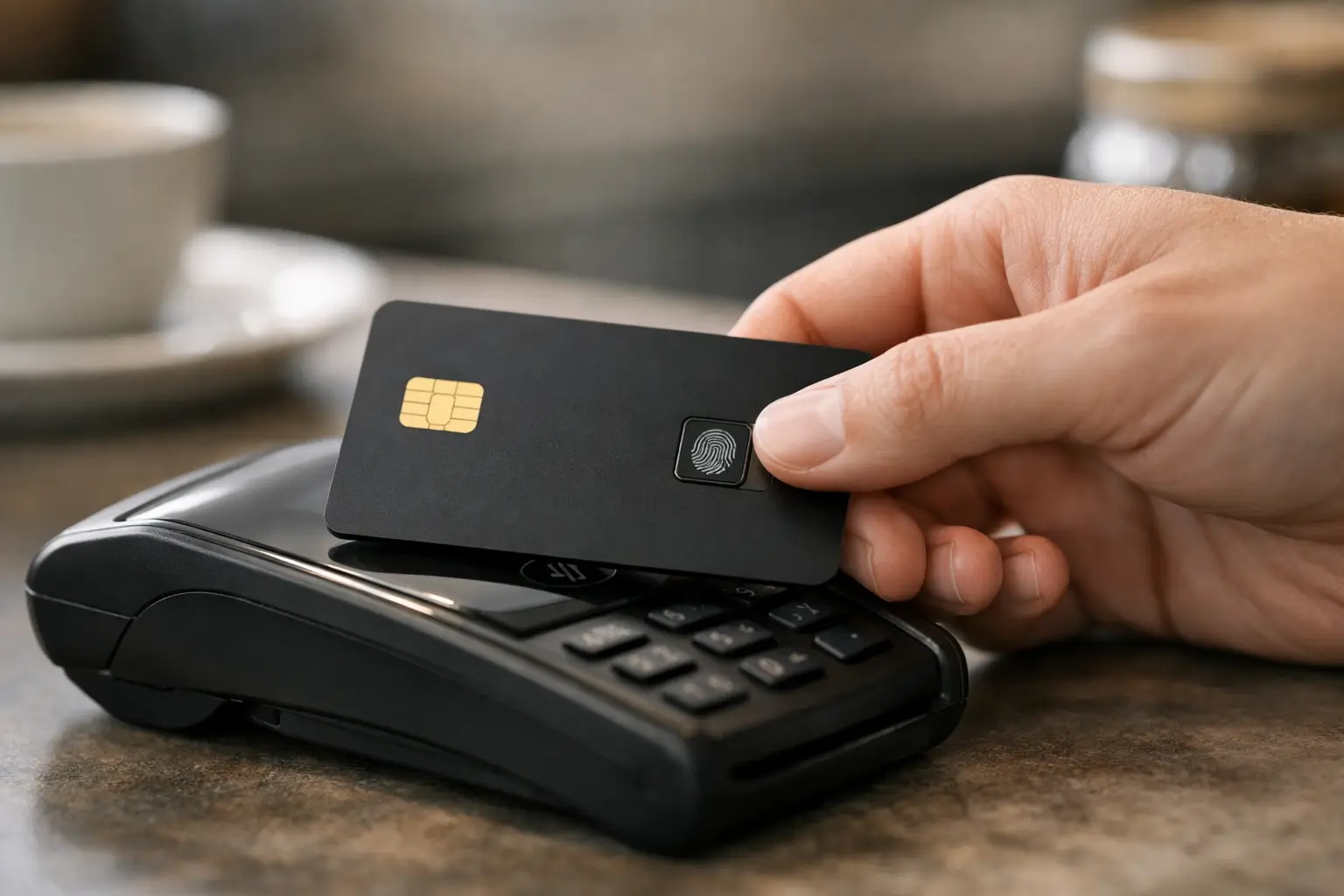

The global fintech landscape is moving toward “Possession-based Authentication.” As we navigate through 2026, biometric smart cards—equipped with ultra-thin ultrasonic sensors—are moving from pilot projects to a standard security offering. This shift addresses the vulnerabilities of knowledge-based security, such as 4-digit PINs, which are increasingly susceptible to sophisticated automated fraud tools.
The Privacy Framework: On-Chip Matching
The primary concern with biometric tech is data privacy. To address this, 2026-standard cards utilize On-Chip Matching. Your fingerprint data is never transmitted to a bank’s server or stored in a central database. Instead, an encrypted mathematical hash is kept within the card’s Secure Element (SE).
Enrollment Methods in 2026
Establishing the initial “handshake” between the user and the card has become a multi-channel experience in 2026:
- Home Setup Sleeves: Battery-powered sleeves allow users to enroll their print privately at home.
- Mobile App Pairing: Leveraging a smartphone’s NFC reader to transfer encrypted biometric hashes from the phone to the card.
- In-Branch Kiosks: For users who prefer professional supervision during the initial setup.
2026 Feature Comparison
| Feature | Traditional EMV Card | Biometric Smart Card (2026) |
|---|---|---|
| Verification | PIN (Knowledge-based) | Fingerprint (Biological-based) |
| Tap Limits | Restricted by Issuer Policy | Higher-Value Tap Potential* |
| Privacy Model | Server-side validation potential | 100% On-Chip Matching |
| Hygiene Factor | Requires Contact with Keypads | Contactless / Personal Sensor only |
*Subject to individual issuer policies and regional regulations.
The Reality of Adoption
While the utility is clear, 2026 remains a period of gradual adoption. Production costs for biometric sensors remain higher than standard plastic, often positioning these cards as a premium tier service for now. Additionally, some legacy terminals in rural or underserved areas may not yet provide the consistent power draw required for instant sensor activation.
Is it Time to Upgrade?
Your decision to switch to a biometric card should depend on your specific needs:
- Security-First: If you carry high-value balances or travel extensively, the biometric layer provides a robust defense against unauthorized “tap-and-run” fraud.
- Tech-Agile: If you use mobile wallets but want a reliable, high-security backup that works even when your phone battery is dead, this is a strategic addition to your wallet.
- Privacy-Conscious: Always confirm that your issuer uses “On-Chip Matching.” If they cannot verify local-only storage, stick to traditional EMV cards for the time being.
 Deep Dive: AI Smart Glasses & Expense Tracking in 2026: From Paper to Vision







1 comment