
I’ll be honest with you: six months ago, if you asked me to build a custom financial dashboard that could talk to my bank and predict my tax liabilities, I would have laughed. I’m not a senior dev. I don’t spend my nights debugging C++. But here we are in 2026, and I just finished building exactly that—using nothing but “vibes” and a revolutionary protocol called MCP.
What Is Model Context Protocol (MCP)?
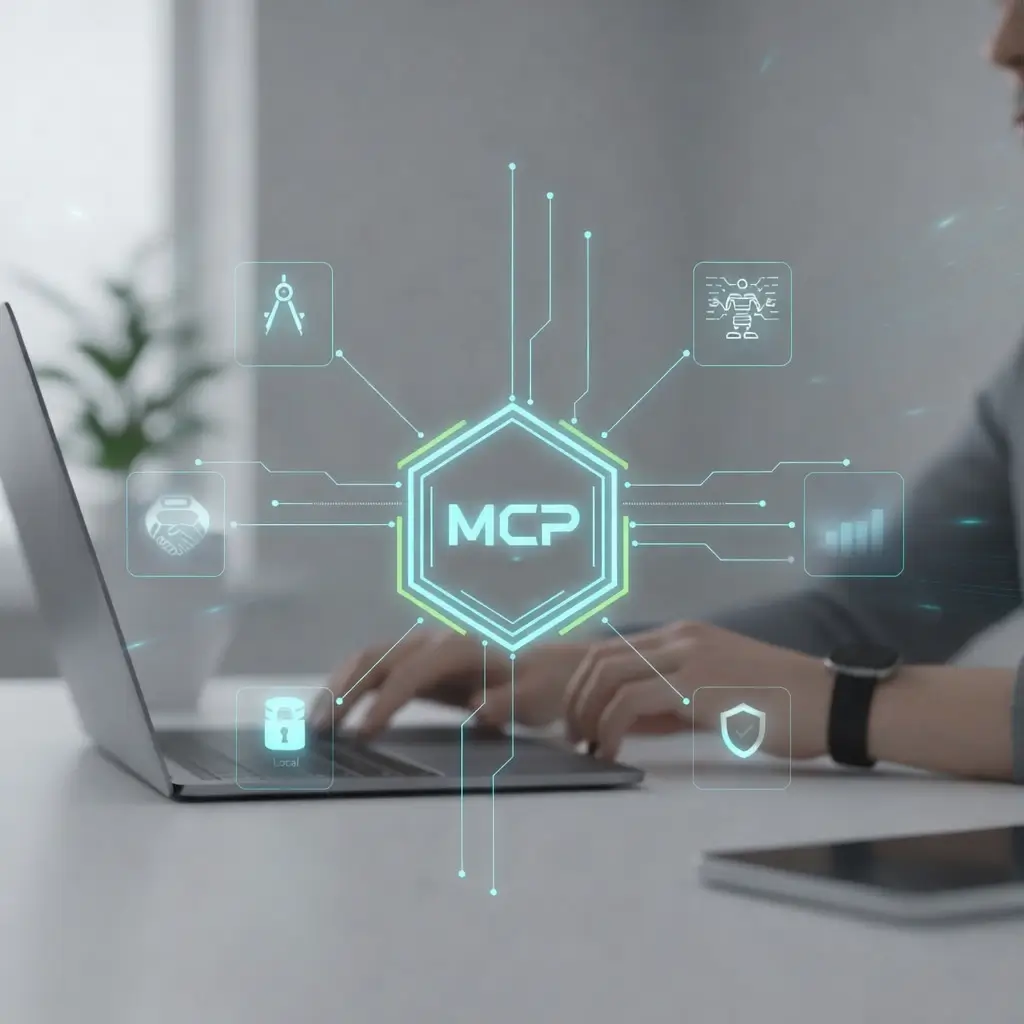
Before we touch a single line of natural language, we need to talk about the Model Context Protocol (MCP). Think of MCP as the universal translator of 2026. In the old days (2023-24), AI was smart but isolated. It lived in a box. MCP allows your AI to step out of that box and securely shake hands with your data—your spreadsheets, your bank’s local API, and even your hardware.
In practice, this MCP connector behaves like a local permissions layer—similar to OAuth, but enforced entirely on-device via a secure bridge daemon. This ensures that when we build a “Private” bot, the word private is doing a lot of heavy lifting. We aren’t sending your salary data to a cloud server; we are keeping it on your Local Sovereign Node.
Phase 1 – Defining the Intent Layer
Vibe coding isn’t about being lazy; it’s about being specific with your intent. I started by opening my agentic IDE and typing my “Vibe Script.” I didn’t write function init(). I wrote a narrative:
“I want a financial agent that monitors my freelance income vs. my recurring subscriptions. It needs to flag any subscription that hasn’t been used in 30 days and suggest a reallocation of those funds into my high-yield index fund.”
The AI doesn’t just see text; it sees a Financial Logic Map. At this stage, I’m acting as the Product Manager, not the coder.
Phase 2 – Multi-Agent Orchestration
In 2026, we don’t work with one AI; we work with a “Squad.” My IDE automatically spun up three distinct agents:
- The Architect: Mapped out how local CSV files would connect to the dashboard via MCP.
- The Builder: Wrote the actual logic, ensuring the bot runs light on my local machine.
- The Security Auditor: Checked every line for data leaks, ensuring bank tokens remained encrypted.
The Reality Check: The first draft wasn’t perfect. The Architect initially overestimated how frequently I wanted alerts—spamming me with every $2 transaction—which forced me to refine my intent. That back-and-forth iteration is where Vibe Coding actually works. It’s a dialogue, not a magic wand.
Phase 3 – Secure MCP Data Connections
This is where the magic (and the technical grounding) happens. To make the bot useful, I needed it to see my real numbers. Using an MCP connector for local financial data, I gave the bot a “read-only” window into my encrypted ledger.
I watched as the Builder Agent established a secure bridge. It requested a Biometric Handshake through my smart ring. Within seconds, the bot analyzed my last 90 days of spending. The “Vibe” was becoming reality through a hard-coded, on-device security protocol.
Phase 4 – Results and ROI
The final product was a 24/7 proactive advisor. Three hours in, the bot sent its first notification:
“Ethan, you have an active $45/month subscription to a 3D rendering tool you haven’t opened since November. If we move this to your ‘Aggressive Growth’ bucket, you’ll reach your 2027 savings goal two months earlier. Execute?”
That is the power of Vibe Coding—automating your financial intelligence without losing control of your data.
Is Vibe Coding Replacing Developers?
We need to stop calling ourselves “non-techies.” If you can describe a problem and orchestrate a solution using AI, you are a builder. While senior engineers are still needed for building the underlying MCP frameworks and complex system architectures, the barrier for utility software has officially vanished. The real skill in 2026 is curiosity and clarity.
SEO Checklist for Documenting Your Build
| Focus Area | Priority Keywords |
|---|---|
| Protocol | Model Context Protocol (MCP), Agentic Workflows |
| Privacy | Sovereign AI, Local Data Residency, On-device Security |
| Methodology | Vibe Coding, Intent-Driven Development |
 Deep Dive:






1 comment