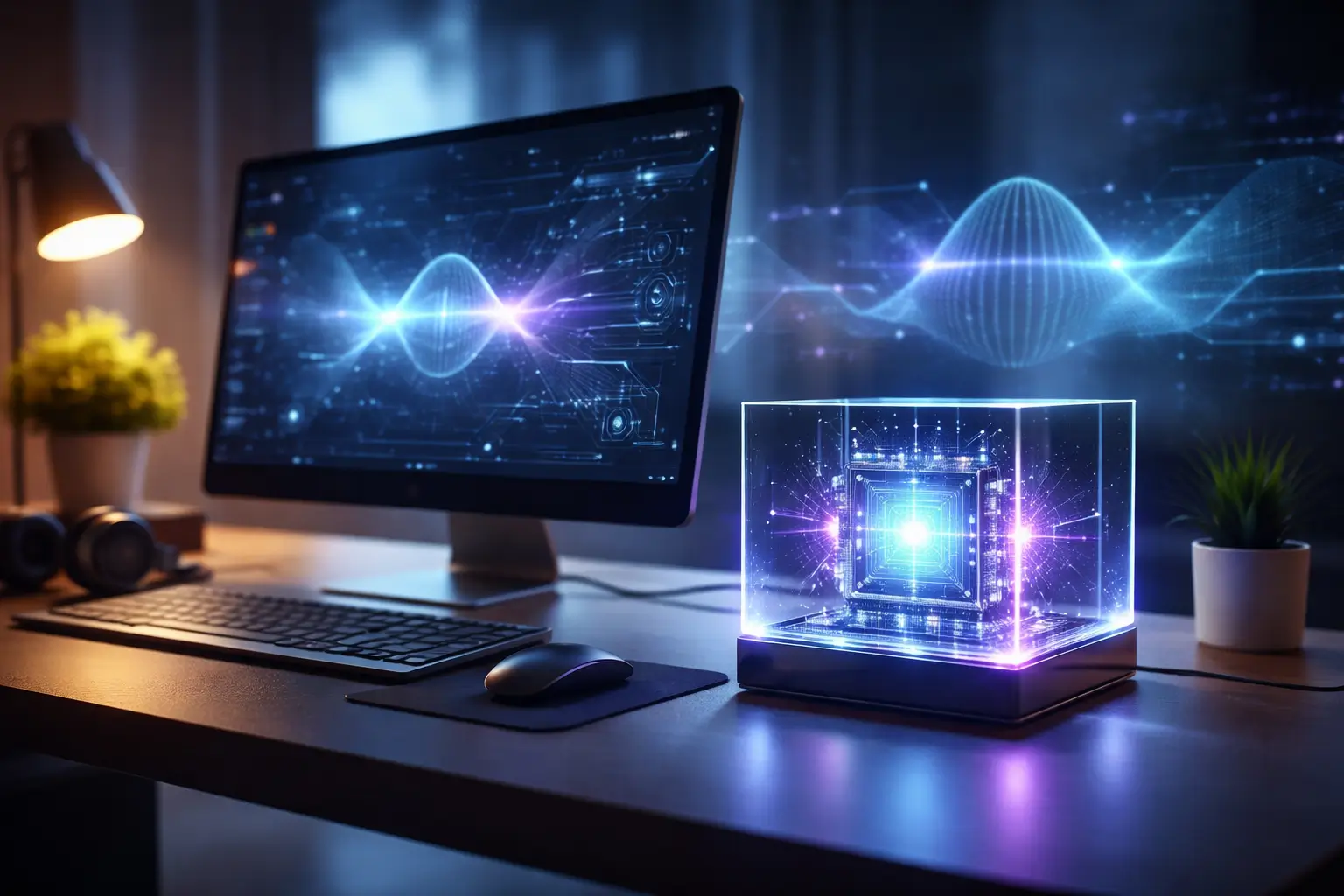
For decades, quantum computing has been the “holy grail” of science fiction. We’ve seen images of massive, room-sized cylinders cooled to temperatures colder than outer space. But as we move through early 2026, a question is buzzing in the tech community: When can I actually put a quantum computer on my desk?
I get it—the idea of having the power to simulate molecular structures or crack complex encryptions from your home office sounds incredible. But before you clear a spot next to your gaming rig, let’s look at what the latest industry data and vendor reports say about the reality of the “Desktop Revolution.”
Current State of Quantum Hardware: From Labs to Desktops
In 2026, we are officially in the era of Hybrid Quantum Computing. According to recent industry reports from tech analysts, while giants like Google (utilizing their latest 105-qubit Willow chip) and IBM are hitting milestones in error correction, these remain industrial-scale machines. However, the “portable” dream is beginning to take shape in niche markets.
Researchers and vendors, such as SpinQ Technology, have already brought the first generation of “portable” quantum systems to market. Models like the Gemini Mini are commercially available. However, according to current industry benchmarks, these desktop-scale systems remain limited to educational use. They function more like “Quantum Calculators” than full-scale PCs.
Why You Can’t Replace Your PC Just Yet
To understand why a total consumer revolution is taking longer than expected, we need to address the technical barriers that quantum physicists and hardware engineers are currently battling.
Qubit Scaling: The Quality vs. Quantity Problem
A standard PC uses bits (0 or 1). A quantum computer uses qubits, which exist in superposition. To perform tasks that outperform a modern laptop, experts suggest we need thousands of logical qubits. Current desktop units offer only 2 to 3. Technical whitepapers indicate that scaling this hardware without losing stability remains the primary obstacle for consumer-grade devices in 2026.
The Decoherence Challenge: Environmental Sensitivity
Quantum states are incredibly fragile. Leading researchers note that even minor environmental noise—like heat or electromagnetic interference from your microwave—can cause “decoherence,” where quantum data is lost. Miniaturizing the necessary protection into a consumer-friendly desktop form factor is a hurdle that 2026 technology is still clearing.
The Rise of “Quantum-as-a-Service” (QaaS)
If you want to experience quantum computing at home today, the revolution isn’t happening in your hardware—it’s happening in the Cloud. Market data from 2025-2026 shows a massive surge in Quantum-as-a-Service (QaaS).
Through platforms like AWS Braket, Microsoft Azure Quantum, and IBM Quantum Safe, you can access real quantum processors from your current laptop. For most users, this cloud-based hybrid model is the actual “Desktop Revolution” we will experience for the next several years.
Future Outlook: Hybrid Systems and QPUs
While a full-blown “Quantum Gaming PC” isn’t sitting on retail shelves yet, industry insiders predict the emergence of Quantum Processing Units (QPUs) as PCIe expansion cards. Just as GPUs handle graphics, these QPUs will eventually handle specific tasks like high-level encryption and AI optimization in high-end workstations.
Actionable Steps for Tech Enthusiasts:
- Don’t wait for hardware: Start learning Qiskit (IBM) or Cirq (Google) today. The software revolution is already here.
- Utilize Cloud Tiers: Use the free tiers of IBM Quantum to run your first circuits. You don’t need a $50,000 machine to start.
- Focus on Cybersecurity: As quantum power grows, start implementing “Quantum-Resistant” encryption (PQC) for your personal data.
Conclusion: The Era of Access
The quantum revolution will not land on your desk as a shiny new PC. It will arrive quietly—through the cloud, through specialized accelerators, and through the software you run.
The future of quantum computing is not a box you will buy. It is a capability you will access. And the people who learn to use it first will be the ones who define the next era of computing. The smartest move in 2026 is not to wait for a physical quantum PC, but to master the quantum power already flowing through your fiber-optic cables.
Related Guide: Sustainable Investing: Top 5 Green Energy Stocks to Watch for Long-Term Growth in 2026