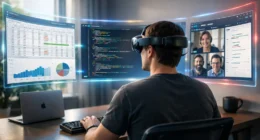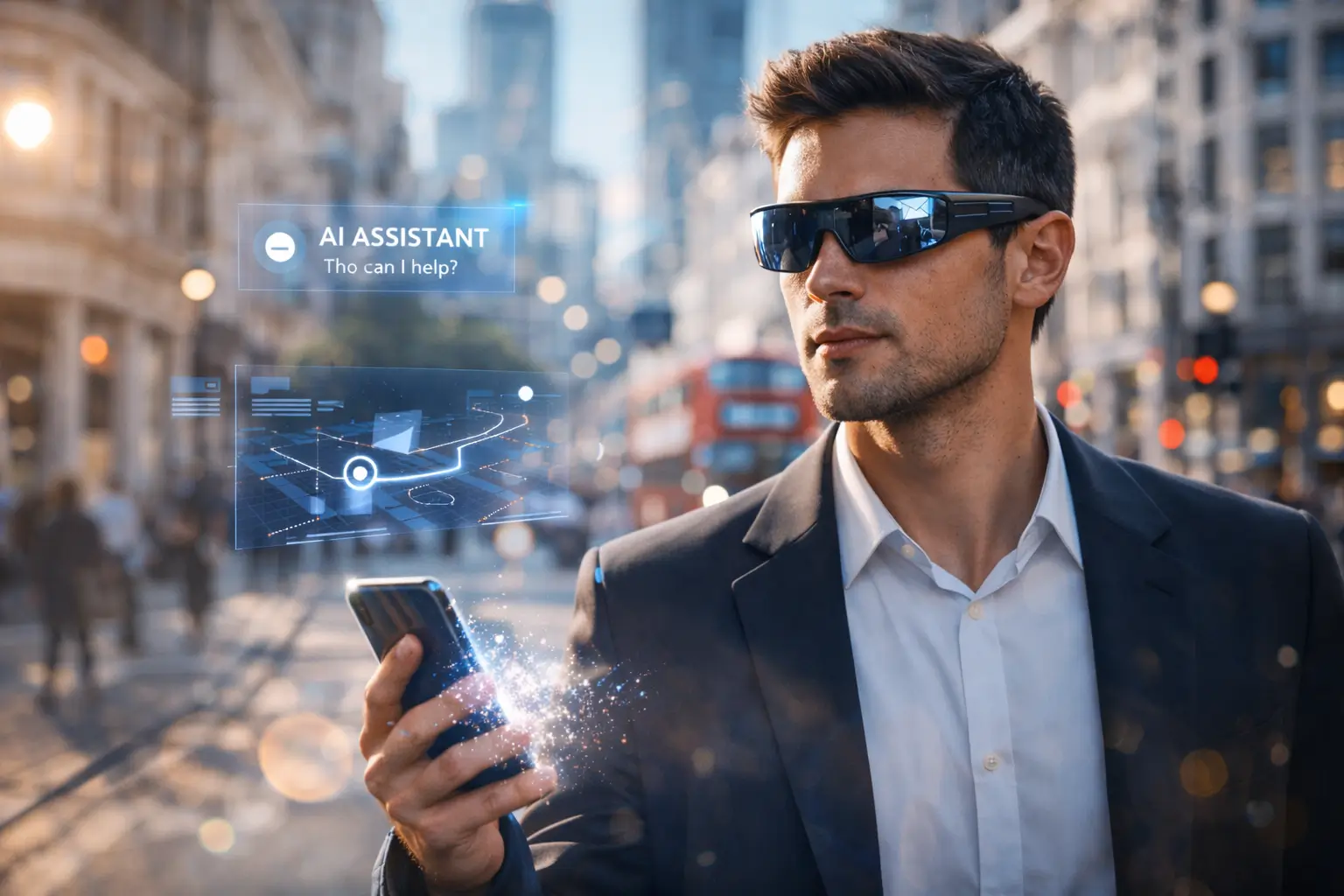
This transition isn’t just about a new gadget hitting the shelves; it’s about the rise of ambient computing devices—technology that is always present, contextually aware, but never demands you to look down. While the handheld device remains a staple for now, its dominance is being challenged by a post-smartphone era vision where our digital and physical realities finally merge.
The 2026 Shift: Why Consumers are “Looking Up”
Market analysts estimate that the adoption of high-end wearables has seen a double-digit percentage increase over the last year. The primary catalyst appears to be a global “screen fatigue.” Consumers, particularly in Tier 1 markets such as the United States and Europe, are increasingly seeking a more natural, “heads-up” way to stay connected without the social friction of constantly checking a phone.
In recent hands-on tech showcases, this new generation of AI wearables has demonstrated that information can be seamlessly overlaid onto our environment. Whether it’s a subtle navigation cue during a morning jog or a real-time translation of a foreign menu, the convenience of hands-free interaction is no longer science fiction—it is becoming a consumer expectation.
The Big Three: The Battle for Your Field of Vision
The tech industry’s heaviest hitters are currently pivoting their entire ecosystems toward this new interface. Here is how the competition is shaping up according to the latest industry reports and leaks.
1. Meta: Redefining Smart Eyewear through Fashion
According to market data from late 2025, Meta’s strategic partnership with EssilorLuxottica has set the current industry benchmark. Industry reports suggest that their latest smart frames have significantly outperformed early sales projections by focusing on aesthetics first. By integrating multimodal AI into a design that looks like traditional eyewear, Meta has successfully addressed the “social awkwardness” that plagued earlier attempts at smart glasses. Their success signals that for a smartphone replacement to work, it must first look like something people actually want to wear.
2. Apple’s “N50” Leaks and the Ecosystem Play
While Cupertino remains officially silent, consistent leaks from supply chain insiders frequently point to a high-priority project codenamed “N50.” Rumored to be a “voice-first, vision-second” device, the N50 is expected to leverage Apple Intelligence to provide a contextual layer over the user’s world. Analysts suggest that Apple isn’t looking to kill the iPhone immediately but rather to transition its core functions to a device that feels like a natural extension of the human senses.
3. Google and the Android XR Ecosystem
Following the early lessons of Google Glass, developer previews for Android XR indicate that Google is taking a more robust, search-centric approach. By integrating its massive Knowledge Graph directly into the user’s field of vision, Google aims to make the physical world “clickable.” This move toward ambient computing allows users to get information about anything they look at—from historical landmarks to products on a shelf—instantly.
The Physical Reality: Why the “Slab” Remains in Your Pocket
Despite the rapid innovation in AI wearables, several technical and social hurdles mean the smartphone isn’t going to vanish from our lives overnight. Understanding these barriers is key to realizing why we are currently in a hybrid era.
1. The Laws of Physics: Battery and Thermal Management
Processing complex AI tasks and powering high-resolution micro-displays requires substantial energy. Current industry reports suggest that most lightweight frames still lack the battery density for all-day standalone use. Consequently, most smart eyewear still relies on a “tethered” wireless connection to a smartphone to handle the heavy computational lifting. Until solid-state battery technology matures, the phone will remain the “central brain” hidden in your pocket.
2. The Privacy and Social Acceptance Gap
From an authoritative standpoint, public perception regarding integrated cameras remains a challenge. For ambient computing devices to achieve the same ubiquity as the smartphone, manufacturers must establish a higher level of transparency and trust regarding data privacy. Social etiquette around “always-on” cameras is still being written, and this remains a significant hurdle for mass adoption in public spaces.
3. Input Precision and High-Level Productivity
While voice and gesture controls have improved drastically, they still lack the haptic precision required for complex tasks. Drafting a 2,000-word report or performing detailed photo editing is still a superior experience on a high-resolution touchscreen. The smartphone remains a tool for creation, while current glasses are optimized for consumption and assistance.
The Verdict: A Disappearing Act
So, is the smartphone dead? In 2026, we are not witnessing the death of the device, but the beginning of its invisibility. We are entering an era where the digital world no longer requires us to stop what we are doing and look down at a piece of glass.
The smartphone won’t disappear—it will simply disappear from your hands.
As these ambient computing devices become more capable, the phone will retreat into our pockets as a silent server, powering the experiences we see through our lenses. If you’re a tech enthusiast or an investor, now is the time to look beyond the screen. The future isn’t in your palm; it’s right in front of your eyes.
Planning a tech upgrade this year? It might be time to consider whether your next “phone” is actually a pair of glasses.