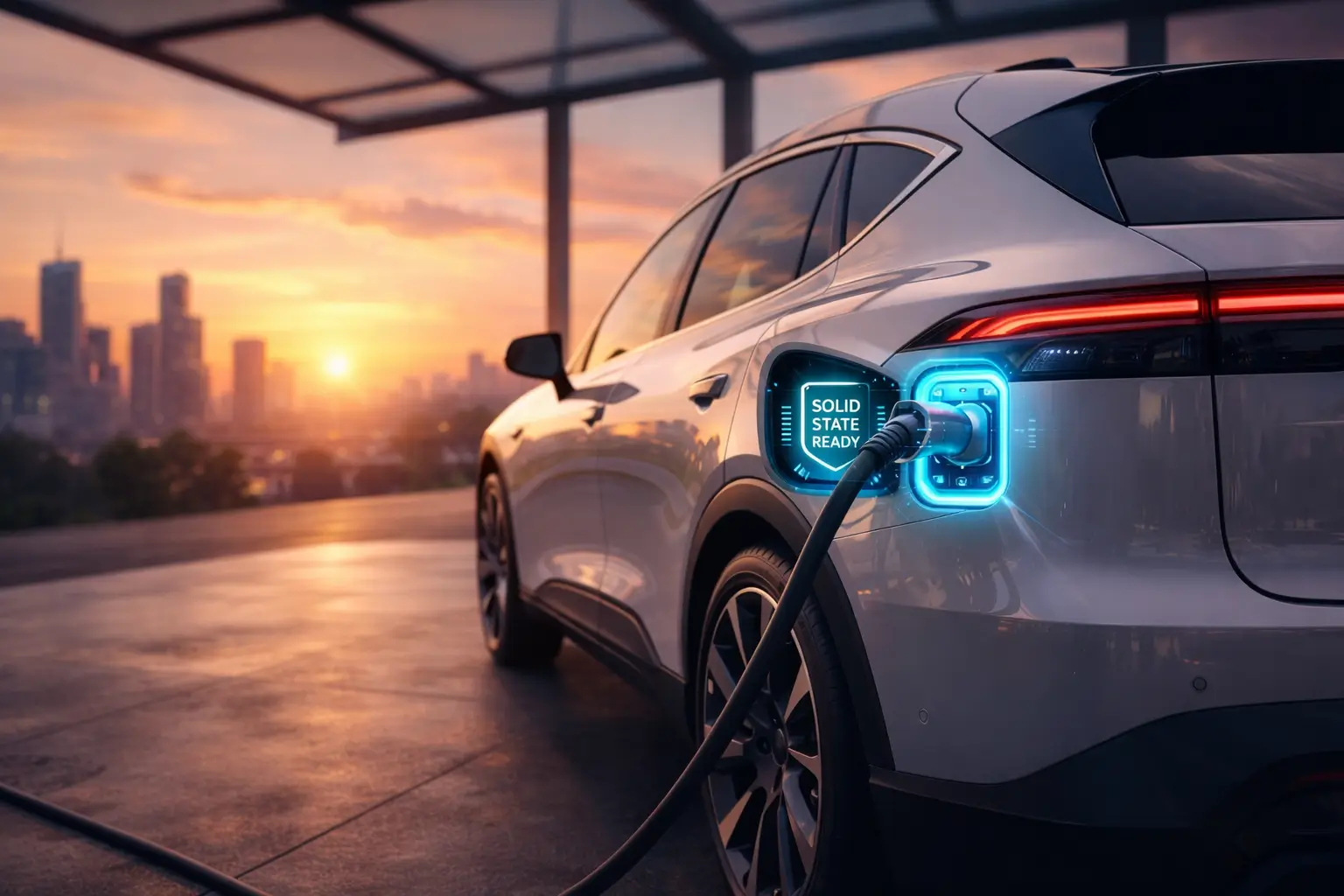
For over a decade, the “5-minute charge” has been the holy grail of the automotive world—a dream always “five years away.” But as we move through 2026, that dream is finally hitting the asphalt. We are no longer just talking about laboratory experiments; we are witnessing the birth of the Solid-State Battery (SSB) revolution.
If you’ve been holding off on buying an electric vehicle because of “range anxiety” or the dreaded 40-minute wait at a charging station, the game has officially changed. From Silicon Valley innovators to global industry giants, the race to eliminate liquid electrolytes is reaching its finish line. Here is how this technology is about to redefine your driving experience.
What Exactly is a Solid-State Battery? (And Why Does It Matter?)
To understand the hype, we have to look at what’s under the hood of current EVs. Today’s popular electric models use Lithium-ion batteries that rely on a liquid electrolyte to move energy. While effective, liquid electrolytes are heavy, can be flammable under extreme stress, and are sensitive to temperature fluctuations.
A solid-state battery replaces that liquid with a stable solid material—usually ceramic, polymer, or sulfide. It’s the equivalent of upgrading from a traditional mechanical hard drive to a high-speed SSD. By using a solid separator, engineers can implement lithium-metal anodes, which can pack nearly double the energy in the same footprint as today’s best batteries.
The Charging Speed: Reality vs. Hype
The primary reason current batteries charge slowly is heat management. Pumping too much power into a liquid-based battery too quickly can cause overheating or the growth of “dendrites”—tiny needle-like structures that lead to internal shorts. Solid electrolytes are significantly more stable and heat-resistant.
In recent industry testing and pilot programs, we are seeing breakthroughs where vehicles can achieve a 10% to 80% charge in as fast as 5 to 9 minutes under controlled conditions. While a universal 5-minute “splash and go” remains the long-term target, achieving a near-full charge in under 10 minutes is the realistic milestone that is currently disrupting the market.
2026 Progress Report: Who is Leading the Race?
The landscape today is divided between pilot-scale production and full-scale commercialization plans:
- Innovation Hubs: Major partnerships in the US and Europe have successfully moved past the “concept” phase. New production lines are now delivering B-sample cells for rigorous real-world road testing in professional test fleets.
- The 1,000 KM Milestone: Leading manufacturers are aiming for a near-future commercial rollout, promising batteries with a range of over 1,000 km (620 miles) on a single charge.
- Early Pilot Applications: We are seeing the first practical uses of this tech in limited-run electric vehicles and performance-focused prototypes. These high-end applications serve as the real-world proving grounds for SSB stability before the technology trickles down to everyday family SUVs.
E-E-A-T Analysis: Is the Revolution Actually Here?
As we analyze the current state of the industry, we must remain grounded. While the technology is “ready,” manufacturing at scale remains the final challenge. Currently, solid-state batteries are primarily appearing in premium, luxury models where the high initial cost of these new materials can be absorbed.
The “Trustworthiness” of this tech depends on long-term durability. Producing millions of microscopic ceramic layers without a single defect is an engineering feat. However, with the launch of AI-driven automated pilot lines, the cost-per-kWh is dropping. We are rapidly moving from “experimental” to “high-end,” and eventually, to the “mainstream standard.”
Why This Matters for Your Wallet (The Investment Angle)
Buying an EV today is a significant financial commitment. The biggest concern for many is depreciation. Traditional Lithium-ion batteries typically degrade over 1,000 to 1,500 full cycles. In contrast, solid-state cells currently in testing are showing 5,000+ cycles with minimal loss. This suggests a solid-state EV could easily last 20 years, retaining its resale value far better than any vehicle currently on the road.
Conclusion: The Smart Buyer’s Strategy
If you need a reliable vehicle today, current EV models are more than capable and highly efficient. However, if you are planning your next major automotive investment, 2026–2027 may be the most important window to watch.
For the first time, “range anxiety” may soon disappear from everyday driving. The solid-state revolution isn’t just about faster charging; it’s about the end of compromises. We are entering an era where electric cars will finally outperform internal combustion engines in every single metric: range, safety, and ultimate convenience.
Read Also: Digital Fortress: Why Post-Quantum Encryption Is the Next Big Step for Online Privacy in 2026