
Introduction: From Trial-and-Error Biology to Programmable Life
For most of modern history, biology has been an observational and experimental science. Progress depended on slow, iterative cycles of hypothesis, wet-lab testing, and refinement. Even with advances in molecular biology and genomics, engineering living systems remained fundamentally probabilistic. Cells were complex, context-dependent, and resistant to deterministic design.
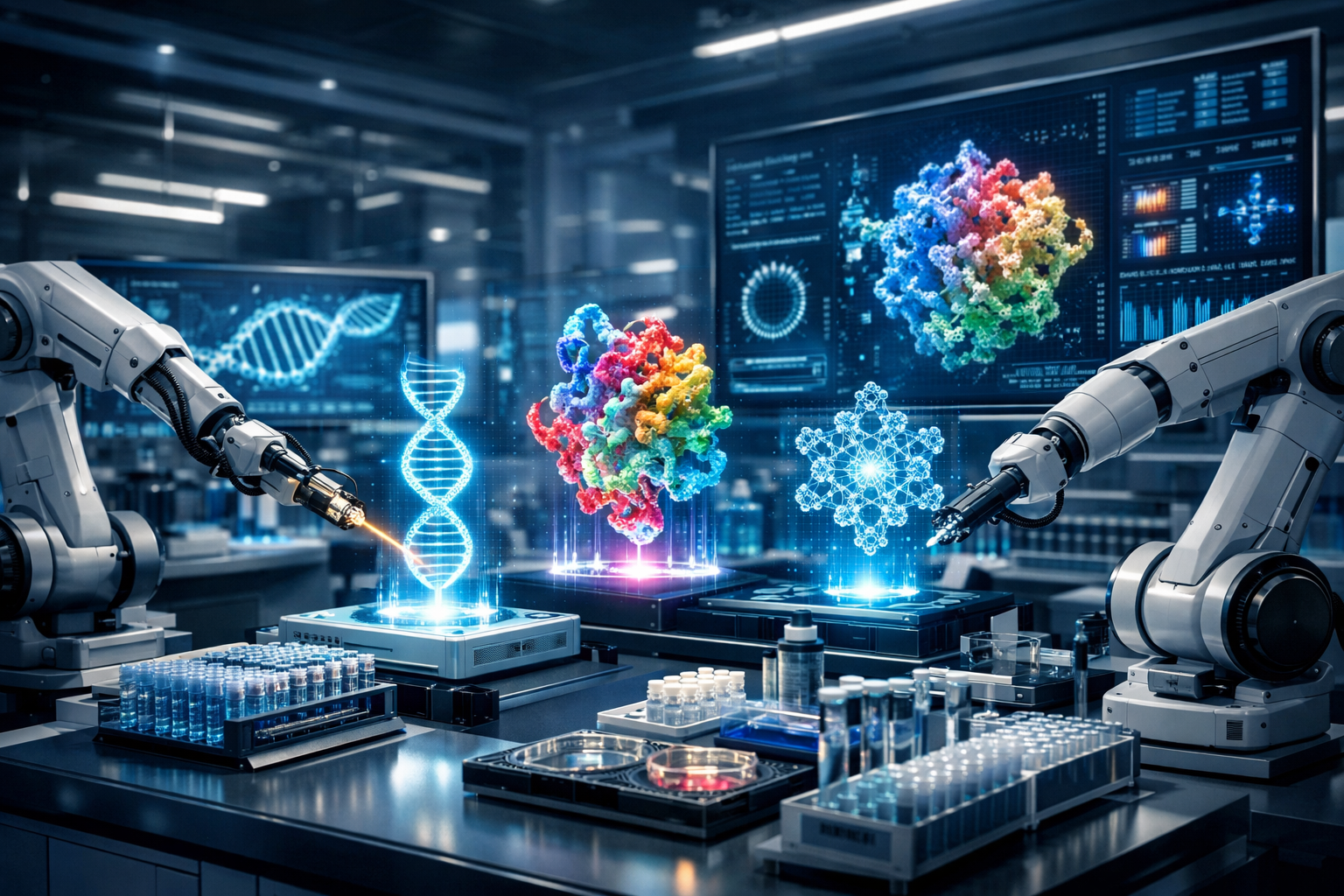
That paradigm is now changing. The convergence of synthetic biology and generative artificial intelligence is transforming biology into an increasingly programmable discipline. At the center of this transformation lies the synthetic bio-foundry: a tightly integrated platform combining AI-driven design, automated experimentation, and large-scale biological data feedback loops. Much like semiconductor fabs enabled the digital age, bio-foundries are emerging as the industrial infrastructure of the programmable biology revolution.
This article explores how generative AI is accelerating synthetic bio-foundries, reshaping drug discovery, materials science, agriculture, and industrial biomanufacturing, while redefining how humans design and deploy living systems.
What Is a Synthetic Bio-Foundry?
A synthetic bio-foundry is an end-to-end system for designing, building, testing, and learning (DBTL) from biological constructs at scale. Its goal is to industrialize biology by reducing cost, time, and uncertainty.
Core Components of a Bio-Foundry
At a high level, modern bio-foundries integrate four tightly coupled layers:
- Design Layer – Computational tools generate DNA, RNA, protein, or metabolic pathway designs.
- Build Layer – Robotic systems synthesize DNA, assemble constructs, and engineer cells.
- Test Layer – High-throughput assays measure expression, function, stability, and performance.
- Learn Layer – Data from experiments feeds back into machine learning models to improve future designs.
Historically, the design and learn layers were weak points. Human intuition and limited statistical models could not fully capture biological complexity. Generative AI fundamentally changes this constraint.
Why Generative AI Is a Breakthrough for Biology
Generative AI models differ from traditional bioinformatics tools because they can create novel biological sequences rather than simply analyze existing ones. Trained on massive datasets of genomic, proteomic, and experimental data, these models learn the underlying rules of biological structure and function.
From Language Models to Biological Models
Biological sequences resemble language in critical ways:
- DNA and proteins are sequential and symbolic
- Meaning depends on long-range context
- Small changes can have large functional effects
This makes transformer-based architectures and diffusion models particularly powerful. Instead of predicting a single outcome, generative models explore vast design spaces and propose high-probability candidates optimized for specific objectives.
Examples include:
- Designing enzymes with improved catalytic efficiency
- Generating protein structures with targeted binding properties
- Optimizing gene regulatory networks for predictable expression
In effect, generative AI becomes a biological design engine.
AI-Driven Design: The Front End of the Bio-Foundry
The most visible impact of generative AI is in the design phase of the bio-foundry workflow.
Protein and Enzyme Design
Traditional protein engineering relied on directed evolution, which required screening millions of variants. Generative AI narrows this search dramatically by proposing candidates that already satisfy structural and functional constraints.
Models can:
- Generate entirely novel protein backbones
- Optimize active sites for specific substrates
- Balance stability, solubility, and activity
This shortens development cycles from years to weeks.
Genetic Circuits and Regulatory Design
Beyond proteins, AI models design promoters, ribosome binding sites, and regulatory elements that control gene expression. This enables more predictable synthetic circuits, a long-standing challenge in synthetic biology.
Instead of trial-and-error tuning, engineers can specify performance targets—such as expression levels or response curves—and allow the model to generate optimized genetic architectures.
Automation and Robotics: Scaling the Build and Test Phases
Design alone is insufficient without rapid experimental validation. Synthetic bio-foundries rely heavily on laboratory automation.
Robotic Wet Labs
Modern bio-foundries use robotic systems to:
- Assemble DNA constructs
- Transform cells
- Run parallel experiments across thousands of conditions
Automation reduces human error, increases reproducibility, and enables true high-throughput biology.
High-Resolution Biological Data
Advanced assays generate rich datasets, including:
- Transcriptomics
- Proteomics
- Metabolomics
- Single-cell measurements
This data density is essential for training and refining generative models. The more experiments run, the smarter the system becomes.
Closed-Loop Learning: Biology as a Self-Improving System
The defining feature of an AI-powered bio-foundry is the closed-loop learning cycle. Each experimental result updates the model, which then proposes improved designs.
Active Learning in Biology
Rather than exploring randomly, AI systems select experiments that maximize information gain. This active learning approach reduces the number of experiments required to reach optimal designs.
Over time, the bio-foundry evolves from a passive tool into an adaptive system that learns the rules of biology specific to its domain.
Industry Applications of AI-Driven Bio-Foundries
The programmable biology revolution is already reshaping multiple industries.
Drug Discovery and Biopharma
AI-enabled bio-foundries accelerate:
- Target identification
- Therapeutic protein design
- Cell line optimization for biologics
This reduces failure rates and compresses timelines for bringing new medicines to market.
Industrial Biotechnology
In chemicals, materials, and energy, bio-foundries engineer microbes to:
- Produce sustainable fuels
- Synthesize specialty chemicals
- Create biodegradable materials
Generative AI optimizes metabolic pathways for yield, efficiency, and robustness under industrial conditions.
Agriculture and Food Systems
Programmable biology enables:
- Nitrogen-fixing crops
- Disease-resistant plants
- Precision fermentation for alternative proteins
AI-driven design ensures traits are both effective and stable across environments.
Strategic Implications: Bio-Foundries as National Infrastructure
As bio-foundries mature, they are becoming strategic assets. Much like semiconductor fabs or AI data centers, advanced bio-foundries concentrate critical capabilities.
Countries and corporations that control:
- High-quality biological data
- Advanced generative models
- Automated experimental platforms
gain disproportionate influence over future food, health, and materials supply chains.
This raises important questions about biosecurity, data governance, and technological sovereignty.
Ethical and Safety Considerations
Accelerating biological design also introduces new risks.
Model Governance and Oversight
Generative models must be constrained to prevent unsafe or unintended designs. This requires:
- Rigorous validation protocols
- Access controls
- Alignment with regulatory frameworks
Responsible Innovation
The power to program biology demands ethical stewardship. Transparency, international cooperation, and clear norms will be essential as bio-foundries scale.
The Future: From Bio-Foundries to Bio-Platforms
Looking ahead, synthetic bio-foundries are likely to evolve into cloud-like biological platforms.
Biology-as-a-Service
Researchers may soon:
- Submit biological design specifications
- Receive optimized constructs
- Iterate digitally before physical execution
This mirrors the evolution of software development and cloud computing.
Human-in-the-Loop Biology
Despite automation, human judgment remains critical. The future bio-foundry is not autonomous biology, but augmented biological intelligence, where humans set goals and constraints while AI explores the solution space.
Conclusion: Engineering Life at Industrial Scale
The synthetic bio-foundry represents a structural shift in how humanity interacts with living systems. By integrating generative AI, automation, and closed-loop learning, biology is transitioning from an empirical science to an engineering discipline.
As programmable biology matures, its impact will extend far beyond laboratories—reshaping medicine, manufacturing, agriculture, and geopolitics. The organizations that master AI-driven bio-foundries will not merely innovate faster; they will define the biological infrastructure of the 21st century.
In this emerging landscape, generative AI is not just accelerating biology. It is redefining what it means to design life.