Just as Wi-Fi 7 became a household name, the tech industry is already buzzing with the next evolution in wireless connectivity. In early 2026, the spotlight has shifted toward the 802.11bn standard, popularly known as Wi-Fi 8. But unlike previous generations that chased record-breaking speeds, Wi-Fi 8 is about something far more valuable: Consistency.
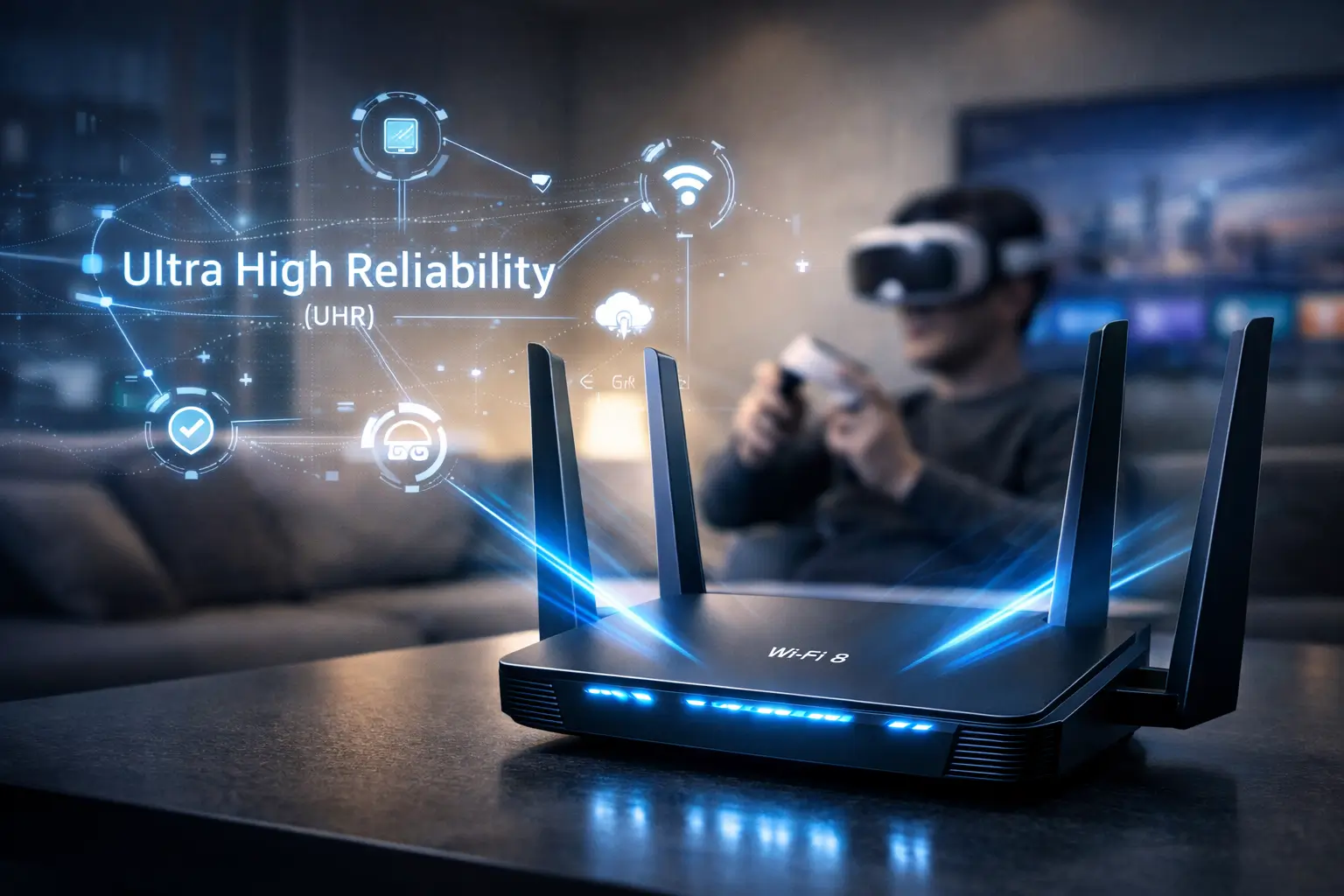
If you’ve ever dealt with “dead zones” or lag during a critical work call, a Wi-Fi 8 router is designed to solve your problems. According to current industry roadmaps, this new standard moves us into the era of Ultra High Reliability (UHR).
What is Wi-Fi 8?
While Wi-Fi 7 pushed theoretical speeds to 46 Gbps, early drafts of the 802.11bn standard suggest that Wi-Fi 8 will maintain a similar speed ceiling but focus heavily on system efficiency. In a 2026 home filled with AI-driven gadgets and smart sensors, the goal isn’t just to be fast—it’s to stay stable under heavy load.
Manufacturers claim that Wi-Fi 8 will be the “traffic cop” of the airwaves, ensuring that your VR headset, smart fridge, and work laptop don’t interfere with each other’s performance. This makes a home network upgrade in 2026 more about quality than just raw quantity.
Key Features of Wi-Fi 8
Multi-AP Coordination
In traditional setups, even high-end mesh systems can suffer from access points “fighting” for the same channel. Wi-Fi 8 introduces advanced Multi-AP Coordination. This allows multiple routers to act as a synchronized team, intelligently scheduling data packets so they don’t collide. This results in a seamless transition as you move from room to room without dropping a single frame of video.
Enhanced Long Range (ELR)
One of the most promising features discussed in recent tech summits is Enhanced Long Range (ELR). By optimizing how signals are broadcast, Wi-Fi 8 can maintain a high-speed connection even through thick walls or at the far edges of a property, potentially reducing the need for expensive signal boosters or multiple extenders.
Lower Jitter for AI and Gaming
In the 2026 landscape of Agentic AI and cloud gaming, “jitter” (the variation in delay) is the enemy. According to early vendor demonstrations and controlled lab simulations, Wi-Fi 8 could reduce jitter by up to 25% compared to its predecessors, providing the near-instant response times required for immersive AR/VR workspaces and competitive online play.
Wi-Fi 8 vs Wi-Fi 7
To help you decide if an upgrade is necessary, here is how the upcoming Wi-Fi 8 standard stacks up against its predecessor in a Wi-Fi 8 vs Wi-Fi 7 comparison:
- Primary Objective: Wi-Fi 7 targets Maximum Throughput; Wi-Fi 8 targets Ultra High Reliability (UHR).
- Network Coordination: Wi-Fi 7 uses independent access points; Wi-Fi 8 uses Collaborative Scheduling across the entire network.
- User Experience: In early controlled lab environments, Wi-Fi 8 demonstrated significantly more stable connections in high-interference areas (like apartment buildings) compared to Wi-Fi 7.
- Latency Management: Wi-Fi 8 introduces specialized protocols to prioritize time-sensitive AI data streams.
Should You Upgrade in 2026?
Is it time to ditch your current setup? Here’s the GAd perspective for your 2026 tech strategy:
- Upgrade if: You have a high density of smart home devices (40+), you are a professional gamer, or you rely on 2026-era AI tools that require constant cloud synchronization.
- Wait if: Your current Wi-Fi 6E or 7 setup is handling your needs without drops, as early Wi-Fi 8 router models are currently in their high-priced “early adopter” phase.
The GAd Verdict
Wi-Fi 8 represents a mature shift in wireless technology. It acknowledges that in 2026, we don’t just need more speed—we need a connection we can trust. While still in its rollout phase, keeping an eye on the 802.11bn standard will be essential for anyone looking to future-proof their digital life and ensure their home network upgrade in 2026 is a success.
Read Also: The Rise of AI Financial Advisors: Can You Really Trust an Algorithm with Your Retirement Fund?